In MRI Rician noise is related to image intensity in magnetic resonance (MR) amplitude images. The Rician noise has Rician distribution. The MRI magnitude images noise is evaluated from images and from correction scheme. Typically, the noise in magnitude MRI images is characterized by Gaussian distribution. We know that pure noise in magnitude is also characterized by Rayleigh distribution. The Rician noise in MRI is the thermal noise due to electrons thermal agitation. In MRI the interactions between static magnetic field and alternating current in gradient coils is the acoustic noise from magnetic resonance imaging (MRI). MRI images noise reduction can be done by convolving the noise with a smoothing function. The outcome is variance reduction in the images. It can be seen as high spatial frequencies reduction in the images. We can evaluate the MRI noises by image data signal – to – noise ratio (SNR). The noise variance is evaluated by the magneto resonance (MR) data quality. MRI image parameters are very important to the results we desire such as segmentation, noise reduction, and parameters estimation, and parameters clustering. MRI noise evaluation can be done by filtering, transform domain, and statistical evaluation. The filtering can be MRI linear filtering or non – linear filtering. The MRI linear filtering is practically done by images cleaning or enhancing. It is done by pixel values replacement with weighted sum of their neighbors, by convolution. The MRI linear works in spatial domain and frequency domain. The MRI non – linear filtering removes noise while preserving edge definition. The Non – Local Means (NLM) techniques can remove Rician noise and gets better image quality in MRI. Typically, MRI non – linear filters are anisotropic filters, non-local means filters, and Bilateral filters. We need to evaluate the performances of those MRI filters. The evaluation is done by inspecting the PSNR, MSE, Entropy, average execution time, and SSIM. The statistical method is maximum likelihood (ML) estimation. Other possible statistical methods are phase error estimation, linear minimum mean square error (MSE), non-parametric estimation, and by doing analysis to function singularity. The machine learning (ML) method is also in use. MRI filtering is also can be done with discrete cosine transform based filters [1,2]. The MRI noise level estimation in background is done by Rayleigh distributed method. The key value is the MRI original signal amplitude (I). The magnitude image M, we get probability density function (PDF) equation
.
I is the amplitude of a noise – free image (original signal amplitude), M is the magnitude MRI image,
is the Gaussian noise variance,
is the modified zero order Bessel function,
is the unit step Heaviside function. The Heaviside step function
is a discontinuous function that acts as an ON/OFF switch. It is equals to zero (0) for negative argument (
) and equals to one (1) for positive argument (
),
. If we have image SNR very low (
) then the Rician PDF (image background) is reduced to Rayleigh distribution. If the image SNR is high enough ( ) then the Rician distribution reduced to Gaussian distribution. The probability density function (PDF) equations for very low and high SNR values are
The Rayleigh noise probability density function (PDF) is given by
where
is the scaling parameter and
is the distributed random variable. The Rayleigh noise is non negative speckle noise. The Rayleigh noise models the two-dimension magnitude where the real and imaginary parts are independent the Gaussian noise. The Rayleigh noise average/mean value is
and the variance is equal to
. The Rayleigh noise distribution is used in Rayleigh – maximum – likelihood filter algorithms for reducing speckled noise and preserving the edges. The Rician noise gives us the probability distributed function (PDF) of MRI pixel magnitude. We divide the Rician noise SNR values to two bands. The first band is related to low SNR values, less than two (SNR<2), where the probability distribution is skewed and “Rician bias” is happened. The “Rician bias” is a phenomenon where the image intensity increased and we get distorting of the low – intensity regions. The second Rician noise SNR values band is high band and the SNR value is beyond three (SNR > 3). Then the Rician noise distribution becomes close to Gaussian PDF,
and the noise is similar to typical additive Gaussian noise. If the signal is equal to zero then Rician distribution is reduced to Rayleigh probability distribution. The Rician noise probability density function (PDF) is given by
, r is the measured intensity (
),
is the signal amplitude,
is the deviation of the Gaussian noise, and
is the modified zeroth – order first kind Bessel function. In MRI images, Rician noise is a non – zero mean noise mainly in low signal regions. We use Non – Local – Means (NLMeans) algorithms for tunning Rician noise. Gaussian MRI noise is a complex Gaussian noise with zero mean and real variance, imaginary variance components. These two real and imaginary variance parts are equal in value. The Gaussian noise is linear type [3,4]. The Rician distributed noise can be approximated by Gaussian distributed noise if the Signal – to – Noise Ratios (SNR) is high enough. The Gaussian noise probability density function (PDF) for pure Gaussian noise component is
, σ s is the intensity of thermal noise and x is the distributed random variable. The MRI images are characterized by magnitude images which are the absolute value of the complex data
. The absolute value operation is nonlinear and change the noise distribution. MRI denoising methods are the way to reduce MRI noise in MRI resonance frequency
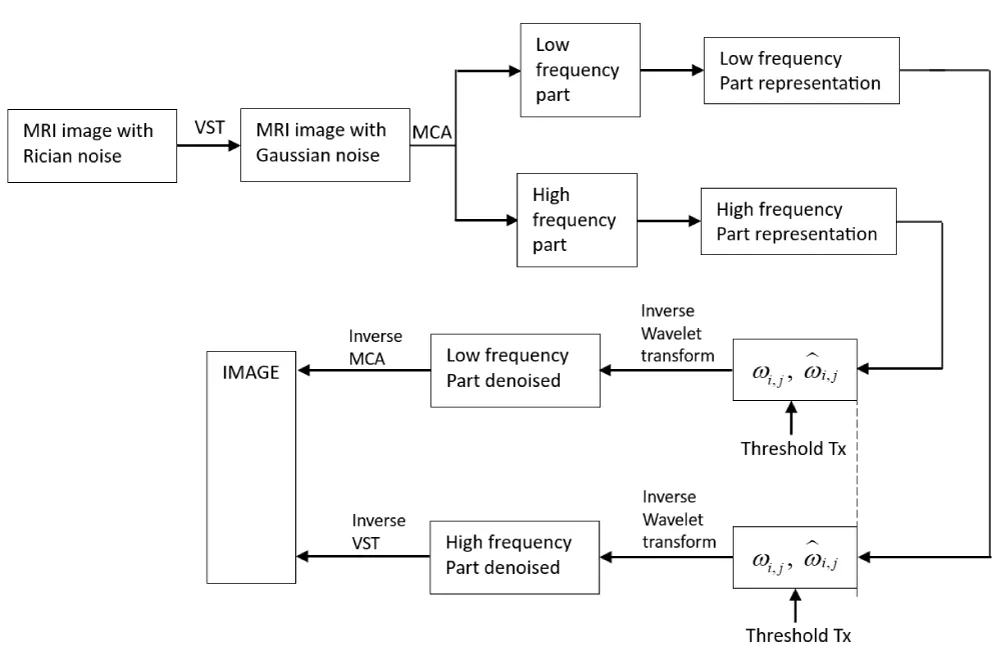
getting better diagnostic quality and clear picture. The MRI denoising methods are filters use or using deep learning. Typically, technologies are 3D filtering (BM3D), Block matching, and non – local Means (NLM). Convolutional neural networks can be the way to achieve MRI denoising. We preserve edges and structural data information while removing noise. Typical denoising algorithm is VST – MCAATE. The peak SNR (PSNR) and similarity index measure (MSSIM) are objective image quality evolution under use. Typical denoising algorithm includes three parts, (1) stabilize noise variance, (2) decompose the image into a textures part and smooth part, (3) locally process the noise. The VST is used to convert the MRI Rician distributed noise to Gaussian noise. Then to implement sparse decomposition of image and unit which fulfil adaptive threshold function [5][6]. The threshold processing is hard threshold and the processing retain the coefficients with greater modules
is the wavelet coefficient of each sub-band on Tx is the adaptive threshold correspond to sub-band.
is the coefficient after threshold (Fig. 1).
The main variable regarding Rayleigh’s, Rician’s, and Gaussian’s distributed noise model is the free image amplitude noise (I). Brainweb simulated brain database or open science framework (OSF) is used for pre calculated Rician and Gaussian noise evaluations. The Brainweb simulated brain database provides simulated MRI data that allow to get “ground – truth” images and the amplitude noise (RF/Thermal) and intensity non – uniformity. The OSF is the open – source medical imaging datasets which includes the raw “clean” data that the simulated noisy images used in MRI. The deep learning noise – reduction models are used as noise – free reference information. The main MRI data noise is thermal or coil – based noise. It follows a complex distribution. We faced problems with filters designed for Gaussian noise which cause blurring and distortion in MRI picture. The resolution is to use Rician noise removal by Non – Local Means (NL – Means) algorithm and 3D autoencoder networks algorithm. The Rayleigh’s, Rician’s, and Gaussian’s distributed noise model delay differential equation (DDE) taken into account the delay in time of amplitude of a noise – free image. Our conclusion is that we can get stable system for right decision of delay parameters values and other system parameters values. The nonlinear theory helps to inspect stable systems by describing the dynamic processes that give an equilibrium state after perturbation. The systems have variable complex behaviours and the stability is evaluated by using Lyapunov stability theory rather than simple linear eigenvalue. It is beyond linear approximations and use core concept such as stable system which phaced small disturbances which convert the system to unstable. It happened if disturbance is beyond specific threshold values. The types of equilibrium and stability are Lyapunov stability (perturb a system from its equilibrium and the state trajectories remain bounded within the region), asymptotic stability (the system is bounded and converges back to the exact original equilibrium point for infinity time (
), and limit cycles (stable, repeating, and oscillating behaviours which do not reside at a single point).
Rayleigh’s, Rician’s and Gaussian’s distributed Noise Model noise – free image amplitude delayed in time
The Rayleigh’s, Rician’s, and Gaussian’s distributed noise model is characterized by differential equation with amplitude of a noise – free image (I) delayed in time due to additional disturbances (interferences). Under variable I delayed in time (
), It becomes
. We consider that the delay parameter in time does not affect the derivative in time of the amplitude of a noise – free image (I). We consider that the amplitude of a noise – free image (I) is real and positive number.
Under the transformation of amplitude of a noise – free image (I) partial derivative to regular derivative
(
), we get the Rayleigh’s, Rician’s, and Gaussian’s distributed noise model delay differential equation (DDE).
I is the amplitude of a noise – free image,
is the amplitude of a noise – free image delayed in time, and the initial condition is [7].
is the Gaussian noise variance.
is the regularization parameter (constant value which balance between data attachment term and regularization function)) which achieved experimentally,
,
, and
are the constants to be set according to noise pattern.
is the noisy image data.
is positive integer,
is the diffusion PDE based prior obtained by minimization of
,
is the diffusion probability density function (PDE) as a function of amplitude of a noise – free image delayed in time.
is related to the minimizing process of the nonlinear energy functional (
) of the image I within
continuous domain by using variational outcome
where
is the regularization function (penalty function).
is the negative likelihood term of Rician or Rayleigh or Gaussian distributed noise in MRI.
is the data attachment term (likelihood term). We get Rician, Rayleigh, and Gaussian noise removal in our system and regularization of MRI data. In
or
, the X indicates the start of a function f which I is the input parameter. We consider for simplicity that
or
are constant parameter (estimation) and equal to
, (
). We get the Rayleigh’s, Rician’s, and Gaussian’s distributed noise model delay differential equation:
At fixed points (system equilibrium points)
and
. We define amplitude of a noise – free image fixed point as I* and the system fixed points are obtained from the equation
then we get I* values and ignore negative values, complex values, and imaginary values (
). By using Taylor series expansion
(
), we approximate the expression
by
. We consider that
is always positive then
,
[8]. We get the approximate Rayleigh’s, Rician’s, and Gaussian’s distributed noise model delay differential equation (DDE):
The Rayleigh’s, Rician’s, and Gaussian’s distributed noise model data fidelity term is derived from the noise model and paired with a regularization penalty function (
). The noise model is responsible for likelihood of observed data while the regularization function is embedding prion the assumption about “true” solution. The regularization function causes to solution space restriction on by that it avoids overfitting. The penalty function is dependent on the expected structure of the signal. Types of regularization functions are L2 (Ridge/Tikhonov) penalty, L1 (Lasso) penalty, and Total Variation (TV),
which is ideal for images which smooths noise while preserve sharp edges and boundaries. By defining the regularization function (penalty function),
as a constant function across specific states interval we get a zero functional resistance. It causes rendering the regularization ineffective in the specific state’s interval. In Rayleigh and Rician noise the regularization function penalize irregularities (noise induced spikes or bias) and vary based on the data for suppression. “Freezing” the regularization function in specific states interval helps our stability analysis.
Rayleigh’s, Rician’s and Gaussian’s distributed Noise Model noise – free image amplitude characteristic equation
We get the approximate Rayleigh’s, Rician’s, and Gaussian’s distributed noise model delay differential equation (DDE) for specific noise pattern constants (
).
The standard local stability analysis about the equilibrium points of Rayleigh’s, Rician’s, and Gaussian’s distributed noise model consists in adding to coordinate I (amplitude of a noise – free image) arbitrarily small increment of exponential form
and retaining the first order term i. The system homogeneous equation leads to a polynomial characteristics equation in the eigenvalue
. The Rayleigh’s, Rician’s, and Gaussian’s distributed noise model fixed values with arbitrarily small increments of exponential form
are:
(first fixed point),
(second fixed point), and
(third fixed point) [9].
We choose the above expressions for our
and
as small displacement term from the system fixed points at time
,
,
. We define
. Submitting
and
expressions with exponential term to Rayleigh’s, Rician’s, and Gaussian’s distributed noise model gives
. The term
is multiplied by
and we get
. We consider
(very small) and we get
.
Multiplication above expression (10) by
gives
We consider
(very small) and we get
We consider
(very small) and we get
The Rayleigh’s, Rician’s, and Gaussian’s distributed noise model under
and
eigenvalue expressions submission
is
At fixed points (
), (equilibrium points)
then
We define the above eigenvalue equation as general characteristic equation
.
We study the occurrence of any possible stability switching resulting from the increase of value of the time delayt for the general characteristics equation D(t). Stability switching is a phenomenon in Delay Differential Equations (DDEs) where an equilibrium point alternates between being stable and unstable as a time delay parameter (t) increases. It often triggers complex behaviours like limit cycles, quasi-periodic oscillations, or chaos. A system that is stable at (t = 0) may lose stability when (t) reaches a critical value. As (t) continues to increase, the roots may cross back into the left half of the complex plane, allowing the system to regain stability, and so on.
The expression for
:
and the expression for
:
.
The expression for
:
;
;
and the expression for
:
;
. The homogeneous system for I leads to a characteristic equation for the eigenvalue
. (1) If
,
then
, (2)
is bounded for
,
. No roots bifurcation from
, (3)
has a finite number of zeros. Indeed, this is polynomial in ω, and (4) Each positive root
of
is continuous and differentiable with respect to
.
;
;
We define
;
(28)
It implies
. Its roots are given by solving the polynomial (
).
Eigenvalue λ = 0 is not a root of the characteristic equation. Furthermore,
,
are analytic functions as the coefficient in P and Q are real. Additionally,
and
thus
may be an eigenvalue of the characteristic equation. The analysis consists of identifying the roots of the characteristic equation situated on the imaginary axis of the complex
plane, by increasing the parameters σ,
, Re λmay, at the crossing, change its sign from (-) to (+), that is from a stable focus E* to an unstable, or vice versa. This feature may be further assessed by examining the sign of the partial derivatives with respect to σ,
parameters. Upon separating into real and imaginary parts, with
and
[10, 11]. When (x) can be any Rayleigh’s, Rician’s, and Gaussian’s distributed noise model parameters s,
and time delay
.
;
(32)
We choose our specific parameter as time delay
.
;
;
and exists
Then
;
.
;
;
;
;
;
(34)
In our Rayleigh’s, Rician’s, and Gaussian’s distributed noise model U = 0.
We know that
and differentiating with respect to
we get
We shall presently examine the possibility of stability transitions (bifurcations) in Rayleigh’s, Rician’s, and Gaussian’s distributed noise model (
,
) about the equilibrium points
I(k) where
, as a result of variation of delay parameter
t. Identifying the τ roots of our system characteristic equation (
) situated on the imaginary axis of the complex
λ- plane. The increasing the delay parameter (
τ), Re
λ may at the crossing, change its sign from – to +, i.e from a stable focus
to an unstable one, or vis versa [12,13]. This feature may be further assessed by examining the sign of a partial derivatives with respect to
parameter,
.
;
;
(
) = constant (43)
We plot 2D function
, where
for different values of
(Gaussian noise variance)
and (amplitude of a noise – free image fixed values)
, and
. Gaussian noise variance (
) determines the spread of random signal noise based on a normal distribution, with values often chosen as small. It has positive numbers (typically 0.01 to 0.5) for image denoising or higher for communication simulations. We already define amplitude of a noise – free image fixed point as
(
) where
. and the system fixed points equation (
,
) is
. We already consider for simplicity that
or
are constant parameter (estimation) and equal to
, (
). In Rayleigh’s, Rician’s, and Gaussian’s noise total variation (TV), the regularization function
and we take the assumption for simplicity
or
(
). Then we two groups of system fixed point for Gaussian noise variance extremum values (
and
). We ignore negative values
of and consider only negative and real values of
.
and the related MATLAB script is
MATLAB (
,
), (Ignore negative value of I*)
clear
Sigma2=0.4;% Other Sigma2 value is 0.49
syms I
eq1 =-(I/(2*Sigma2*sqrt(I*I+ Sigma2)))+1==0;
S = vpasolve([eq1],[I]);
sol = S;
T = array2table(sol,'VariableNames',{'I*'})
T = I* (σ2 = 0.4): 0.84327404271156782186637161184872
I* (σ2 = 0.49): 3.4472797063390974189285512990244
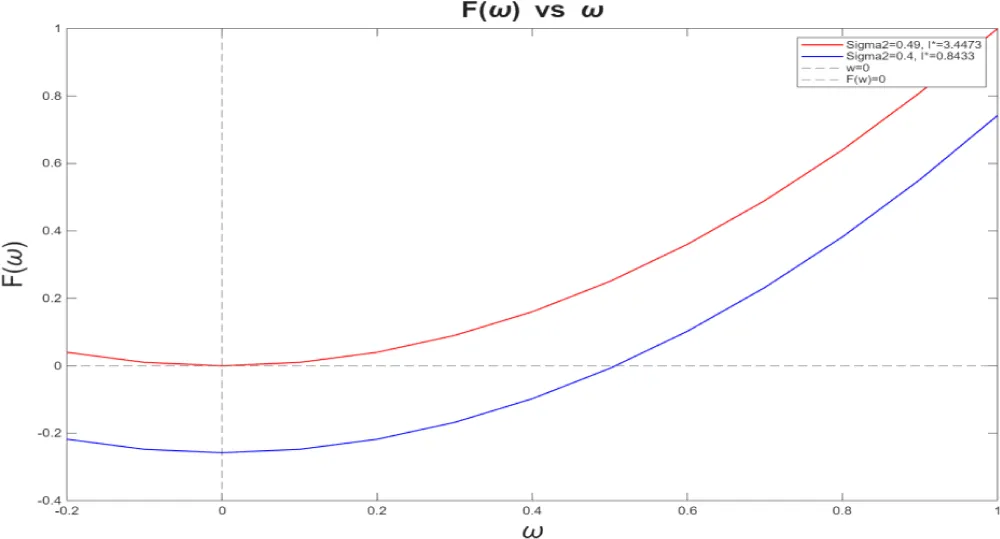
We plot two 2D functionsand
and
, (Figure 2).
Figure 2:
functions (
,
)
We find the values
that fulfil
and only for those values there can be stability switch-ing. We ignore negative, complex, and imaginary values. The stability switching function does not depend on τ parameter. We plot 2D graphs (
) for different values of
and
which is
(fixed points),
. We plot
function and detect the sign. We check for which τ parameter values ω satisfy the equations
and
, where
and
. The function
is related to control theory and delay differential equations (DDEs), the func-tion
appears in Geometric Stability Switch Criteria. It used in our case to analytically determine the criti-cal frequencies (ω) where a system changes between stable and unstable states as a time delay parameter (τ) var-ies. The function
typically represents the magnitude difference between the polynomial components of the system's characteristic equation.
Figure 1: MRI denoising method flow chart.
Rayleigh’s, Rician’s and Gaussian’s distributed Noise Model noise – free image amplitude characteristic equation
,
,
We get the approximate Rayleigh’s, Rician’s, and Gaussian’s distributed noise model delay differential equation (DDE) for specific noise pattern constants (
).
The standard local stability analysis about the equilibrium points of Rayleigh’s, Rician’s, and Gaussian’s distributed noise model consists in adding to coordinate I (amplitude of a noise – free image) arbitrarily small increment of exponential form
and retaining the first order term i. The system homogeneous equation leads to a polynomial characteristics equation in the eigenvalue l [14]. The Rayleigh’s, Rician’s, and Gaussian’s distributed noise model fixed values with arbitrarily small increments of exponential form
are: k = 1 (first fixed point), k = 2 (second fixed point), and k = 3(third fixed point).
;
(46)
We choose the above expressions for our
and
as small displacement term from the system fixed points at time t = 0,
,
. We define
. Submitting
and
expressions with exponential term to Rayleigh’s, Rician’s, and Gaussian’s distributed noise model gives
. The term
is multiplied by
and we get
. We consider
(very small) and we get
.
At fixed points exist
then we get the system eigenvalue equation
We define the above eigenvalue equation as general characteristic equation D(τ).
We study the occurrence of any possible stability switching resulting from the increase of value of the time delay τ for the general characteristics equation D(τ).
The expression for
:
and the expression for
:
.
The expression for
:
;
;
and the expression for
:
;
. The homogeneous system for
leads to a characteristic equation for the eigenvalue
. (1) If
, then
, (2)
is bounded for
,
. No roots bifurcation from
, (3)
has a finite number of zeros. Indeed, this is polynomial in ω, and (4) Each positive root
of
is continuous and differentiable with respect to
.
;
(55)
;
(56)
It implies
. Its roots are given by solving the polynomial (
).
Eigenvalue λ=0 is not a root of the characteristic equation. Furthermore,
,
are analytic functions as the coefficient in P and Q are real. Additionally,
and
thus
may be an eigenvalue of the characteristic equation. The analysis consists of identifying the roots of the characteristic equation situated on the imaginary axis of the complex λ plane, by increasing the parameters σ,
,
,
may, at the crossing, change its sign from (-) to (+), that is from a stable focus E* to an unstable, or vice versa. This feature may be further assessed by examining the sign of the partial derivatives with respect to σ,
parameters. Upon separating into real and imaginary parts, with
;
. When (x) can be any Rayleigh’s, Rician’s, and Gaussian’s distributed noise model parameters σ,
and time delay τ [15].
;
(61)
We choose our specific parameter as time delay
.
;
;
and exists
Then
;
;
;
;
;
;
In our Rayleigh’s, Rician’s, and Gaussian’s distributed noise model
.
We know that
and differentiating with respect to τ we get
;
;
;
(68)
We shall presently examine the possibility of stability transitions (bifurcations) in Rayleigh’s, Rician’s, and Gaussian’s distributed noise model (
,
,
) about the equilibrium points I(k) where
, as a result of variation of delay parameter τ. Identifying the roots of our system characteristic equation (
) situated on the imaginary axis of the complex λ - plane. The increasing the delay parameter (τ),
may at the crossing, change its sign from – to +, i.e from a stable focus
to an unstable one, or vis versa. This feature may be further assessed by examining the sign of a partial derivatives with respect to parameter,
;
,
,
,
(
) = constant (72)
We plot 2D function
, where
,
,
for different values of σ2 (Gaussian noise variance) and I(k)(amplitude of a noise – free image fixed values)
, and
. Gaussian noise variance (σ2) determines the spread of random signal noise based on a normal distribution, with values often chosen as small [16]. It has positive numbers (near
is between 1 and 10) for image denoising or higher for communication simulations. We already define amplitude of a noise – free image fixed point as
(
) where
. and the system fixed points equation (
,
) is
. We already consider for simplicity that
or
are constant parameter (estimation) and equal to
, (
). In Rayleigh’s, Rician’s, and Gaussian’s noise total variation (TV), the regularization function
and we take the assumption for simplicity or
(
).
is a positive used to calculate the Rician noise, and getting the desired output at one in the adapted method (
). Then we two groups of system fixed point for Gaussian noise variance extremum values (
and
).
and the related MATLAB script is
MATLAB (
,
)
clear
Sigma2=1;% Other Sigma2 value is 10
syms I
k1=1;
eq1 =-((I/Sigma2)-(2*k1/I))+1==0;
S = vpasolve([eq1],[I]);
sol = S;
T = array 2 table (sol,'VariableNames', {'I*'})
T =
I* (
): (Ignore negative value)
-1.7082039324993690892275210061938
11.708203932499369089227521006194
I* (σ2 = 1):(Ignore negative value)
_______________
-1.0
2.0
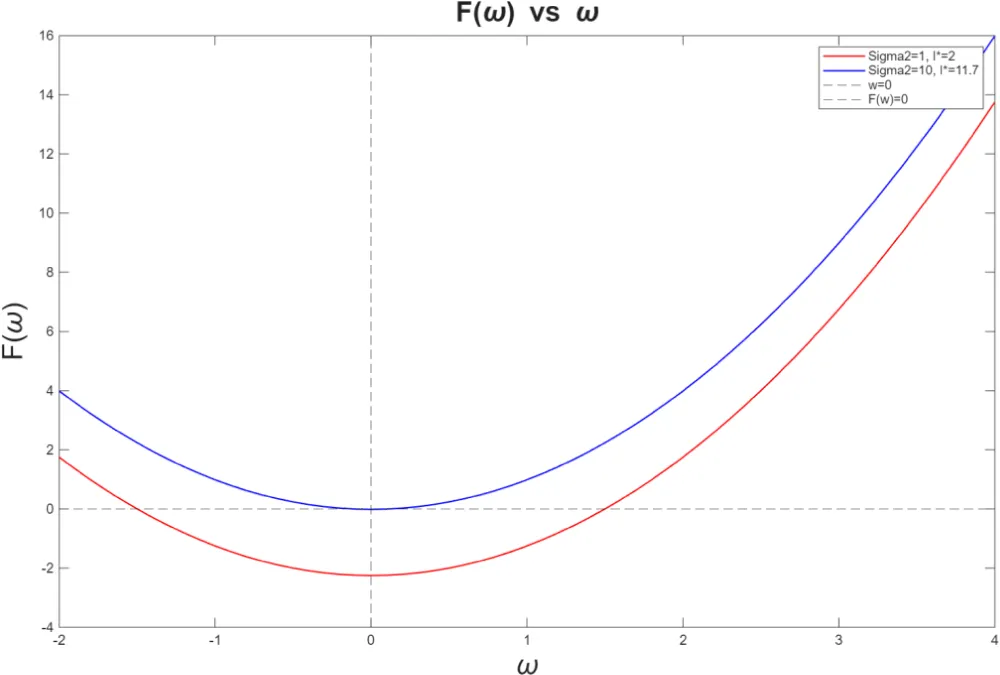
We plot two 2D functionsand
and
(Figure 3).
Figure 3:
functions (
,
)
We find the values
that fulfil
and only for those values there can be stability switching. We ignore negative, complex, and imaginary values. The stability switching function does not depend on τ parameter. We plot 2D graphs (
) for different values of σ2 and I(k) which is I* (fixed points),
. We plot
function and detect the sign. We check for which τ parameter values ω satisfy the equations
and
, where
and
[17].
Discussion
The time delay (t) in MRI image amplitude is basically comes from the hemodynamic response in fMRI and macroscopic blood flow transit times. The MRI system physical hardware limitations cause to time delays in MRI image amplitudes. The delay outcome is direct result from measurable phase shift and temporal dispersion between underlying event and the signal amplitude we get. In real MRI system the physical delay between the radio frequency (RF) excitation pulse and the echo peak establish the degree of transverse magnetization loss. The exact amplitude at image building is dependent on exponential relaxation times. Additionally, the ramping magnetic field gradients up and down cause to hardware heating and induced eddy currents. The eddy currents distort the magnetic field and require physical time delays in sequence timing to correct the phase errors before the sampled data. In MRI the k – space sampling efficiency is the key element. MRI conventional sequences fill the spatial frequency domain (k – space) sequentially. The physical limitations in gradient slew rates have effect of acquiring multi shot data which required spatial encoding delays. It influences the speed of image amplitude mapping and update.
Conclusion
In MRI medical analysis the noise is very crucial mater. The MRI data noise influences the quality of imaging pictures. The complex additive white Gaussian noise (AWGN) can model the MRI data noise. It is especially in the raw k – space data. It follows a zero – mean Gaussian distribution (real and imaginary components). By getting magnitude images the noise becomes Rician distributed noise. It is mainly at low SNR and also at non – central chi distributed for multi – coil datasets. The statistics noise analysis is implemented in image processing applications (MRI). The noise in MRI is typically modelled by using stationary process (Rician distribution). The MRI coil is view in the concept of coil signal acquired complex Gaussian model. Magneto Resonance (MR) thermal noise is subjected to the image and the electronics noise which happened during the process of acquisition of the signal in magnet resonance (MR) receiver chain. It is related to the stochastic motion of free electrons in the MRI RF coil. It is very important in MRI to model the noise for improving the magneto resonance (MR) image quality. The MRI noise is magnitude reconstructed images is inspected for specific distribution. The MRI noise model is dependent on SNR values with the raw complex model and the final magnitude domain. The Rayleigh noise distribution is specific case of Rician distribution noise which occurs for zero signal intensity or low signal intensity compare to the noise. There are some MRI noise distributions under inspection such as Gaussian (complex raw data at any SNR), Rayleigh (background (air) at low or zero SNR), Rician (tissue foreground at low SNR (SNR < 2 dB)). The Gaussian distribution can be also for high SNR (SNR > 3) for the tissue foreground. The MRI magnitude image is the key point in subsequent transform and the Rician distribution is the key element. The original signal amplitude (I) gives us the probability density function (PDF) related to the magnitude image (M) value is
. Then the Rician probability density function is reduced to Rayleigh distribution and the expression for high SNR value (SNR > 3 dB). The Rician distribution with higher SNR value becomes Gaussian distribution. The minimization process gives us the Rician Rayleigh and Gaussian noise removal and MRI data regularization. We use the maximization process of log – likelihood or minimization of the negative log – likelihood and get de – noising of image data. All of that bring us to Rayleigh’s, Rician’s, and Gaussian’s distributed noise model which present by differential equation with amplitude of a noise – free image (I) as the main variable. Due to disturbances (interferences) there is variable I delay in time which influence the system dynamical stability. The key factors which influence the system stability and stability switching behaviour are the Gaussian noise variance (
) value, amplitude of a noise – free image fixed point values I(k) .
(
), and delay parameter (τ) which related to I variable. Other system parameters are chosen for typical values. We get the stability dynamical behaviour for two cases, first case
;
and second case
,
,
, and plot the stability scheme. The values of Gaussian noise variance (σ2) are chosen close to the phenomena of stability switching scenario. The outcomes and results give clear picture on system dynamic and stability behaviour [18,19].



 Save to Mendeley