Annals of Mathematics and Physics
Twice Punctured Euclidean and Hyperbolic Manifolds, Revisited as a Hypothetical Explanation for Quantum Dots
Department of Algebra and Geometry, Institute of Mathematics, Budapest University of Technology and Economics, Hungary
(Presented first in Algebra and Geometry Seminar, 05 March, 2024, and at international conferences, including the XII BGL Conference in Budapest (1–3 May 2024), as a CERN Indico events)
A 40-Year Retrospective Honoring the 2023 Nobel Prize Laureates in Chemistry, and also the 200th anniversary of János Bolyai’s work on absolute geometry
Author and article information
Cite this as
Molnár E. Twice Punctured Euclidean and Hyperbolic Manifolds, Revisited as a Hypothetical Explanation for Quantum Dots. Ann Math Phys. 2026;9(3):81-87. Available from: 10.17352/amp.000184
Copyright License
© 2026 Molnár E. This is an open-access article distributed under the terms of the Creative Commons Attribution License, which permits unrestricted use, distribution, and reproduction in any medium, provided the original author and source are credited.Abstract
Upon reading a newspaper article from December 2023, I realized that my 1984 conference paper might provide a possible explanation relevant to the Nobel Prize in Chemistry awarded to Alexey Yekimov, Luis E. Brus, and Moungi G. Bawendi. After corresponding with my colleague, Academician István Hargittai, he extended his congratulations. I subsequently presented the topic at several conferences in 2024, including those held in Budapest, Sopron, Belgrade, and Senj.
Naturally, the author could not have anticipated the relevance and significance of the topic at that time. This was an incidental consequence of my earlier erroneous paper [2], intended to construct an infinite series of non-orientable compact hyperbolic manifolds as a polyhedral tiling series in the Bolyai-Lobachevsky hyperbolic space H3. Fortunately, I observed and improved the mistake soon. Specifically, those constructions were not manifolds because the two fixed-point orbits represent punctures where point reflections (central inversions) occur in the symmetry group of the tricky polyhedral tilings.
But these singular points, interpreted as 'quantum dots' (e.g., copper and chlorine ions), respectively, in a silicon-based glass fluid that subsequently solidifies produce optical effects (due to electron transitions) whose colors might depend on the sizes of crystal particles.
This suggests that the unexpected result was more significant than the original intention that could be reached easily later!
The main point of this paper is that – in addition to an Euclidean crystal group 61. Pbca – I constructed infinitely many hyperbolic space groups (in Bolyai-Lobachevsky space) possibly providing such a material.
1. Introduction and original background documents
A complete connected Riemannian n-dimensional manifold of constant sectional curvature is briefly called a space form. Intuitively, each space form is locally isometric to one of the classical n-spaces of constant curvature. It is well-known that each space form can be represented as an orbit space M/G.
Manifolds and 'Twice Punctured Manifolds'
Here M is one of simply connected n-spaces of curvature K, i.e. M is either a spherical (K > 0) or the Euclidean (K = 0) or a hyperbolic n-space (K < 0). The isometry group G acts discontinuously and freely on M, i.e. there is a nonempty open set V in M so that no two distinct points of V are equivalent under G, moreover, the identity 1 is the only element of G which has fixed points. Then G can be considered as the fundamental group of the manifold M/G.
There are 'twice punctured manifolds' which have two exceptional singular points with „half-ball-like" neighbourhoods, where the centrally opposite points are glued together. Such a fundamental group G has two singular orbits; that is, M/G is 'twice punctured'.
1.1. Dia 6. Euclidean example 61. Pbca
Orientation-preserving transformations:
1 (x1, x2, x3) the identity --- s1 (½ + x1, ½ - x2, -x3); s2 (-x1, ½ + x2, ½ - x3); s3 (½ - x1, -x2, ½ + x3) represent screw motions
Orientation reversing transforms:
-1 (-x1, -x2, -x3) a point reflection (at the origin) --- b (½ - x1, ½ + x2, x3): OAEC =: b-1 → FBDG =: b; c (x1, ½ - x2, ½ + x3); a (½ + x1, x2, ½ - x3) glide reflections
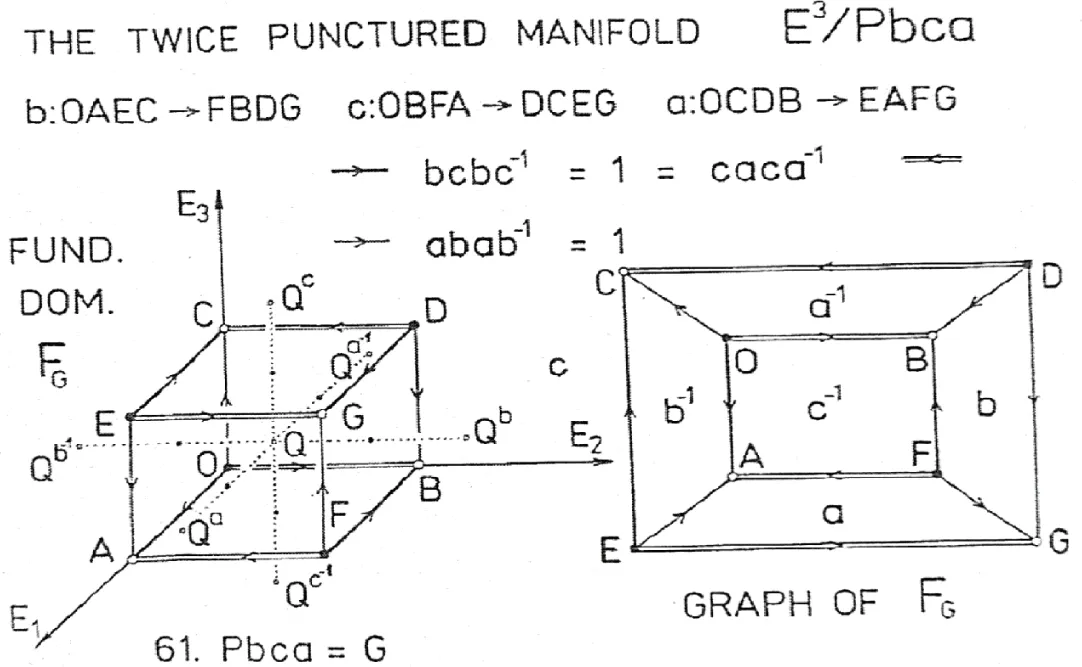
A supergroup occurs: 205. Pa3− =: G~, If FG is a cube, then a threefold rotation occurs around OG.
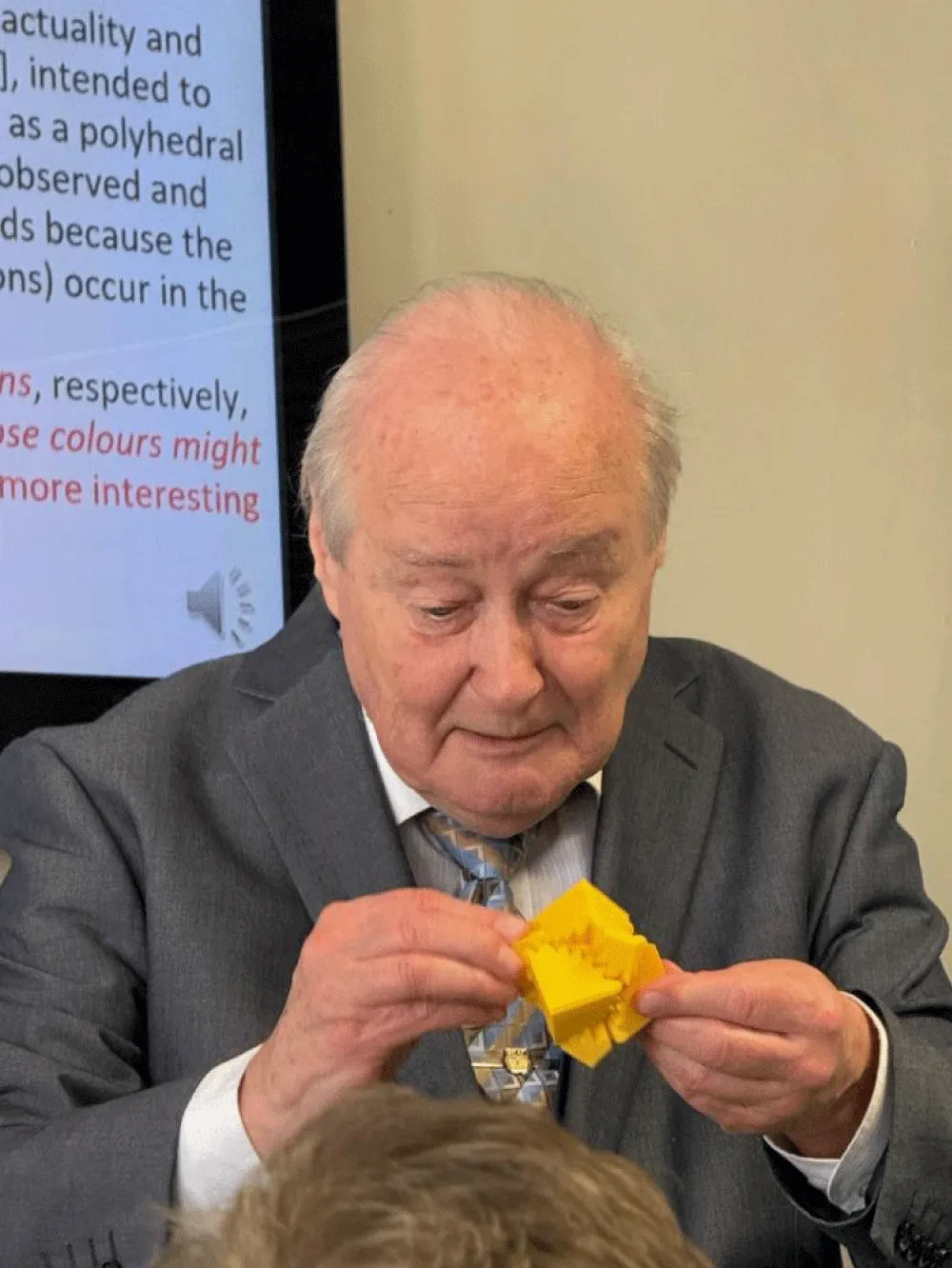
Then at later presentations a movable “wonder cube” model (recently presented to me by Endre Budai, a teacher colleague in Teleki Blanka Gymnasium of Székesfehérvár, provided the following internet link https://www.thingiverse.com/thing:10483) incidentally illustrated this nano-size situation. The opposite vertices (with bigger part (Cu), smaller part (Cl) can be (trigonally) rotated.
Péter SZABÓ, University of Sopron, produced this cube model using a 3D printer in more variants.
1.2. To 61. Pbca = G in figure of former dia 6
The fundamental domain (asymmetric unit) FG of 61. Pbca = G geometrically describes this group (e.g. in [4]) in the orthorhombic coordinate system OE1E2E3, where the lengths of basis vectors OEi := |ei| = ai (i = 1, 2, 3) are given parameters (by measuring the material crystal, to be determined). An orthorhombic lattice ΛG of G is given by integer coordinate triple to the identity transform 1 (as linear part). as defined in our conventions, each α(A, a) ∈ G can be given by mapping ∝: X ↦ XA + a =: X∝ = Y with A by linear integer unimodular matrix to the basis (ei = OEi) above, and the translational component a, as illustrated in dia 6, the position vector is OX = X = xiei (Einstein-Schouten summing index convention), the above Y is the image.
Assume that O, D, E, F are G-equivalent point reflection centres, say with copper (Cu) ion parts, and similarly G, A, B, and C., are with Chlorine (Cl) ion parts, so that the fundamental cube FG contain also "central" silicon (Si) atom in OG and 2-2 ones at the 3 opposite face pairs of FG, equivalent by glide reflections b, c, a, respectively. Assume that these (approximate) proportions 1/2 : 1/2 : 7(?) of atoms Cu, Cl, Si can form crystal particles of appropriate cubic size, and these particles float in a silicon fluid that freezes. The singularities (as constraints) near Cu and Cl ions cause electrons “jumping-leaping” with light effects, i.e. quantum dots. This may have applications in display technologies. e.g. TV screen.
2. Hyperbolic series
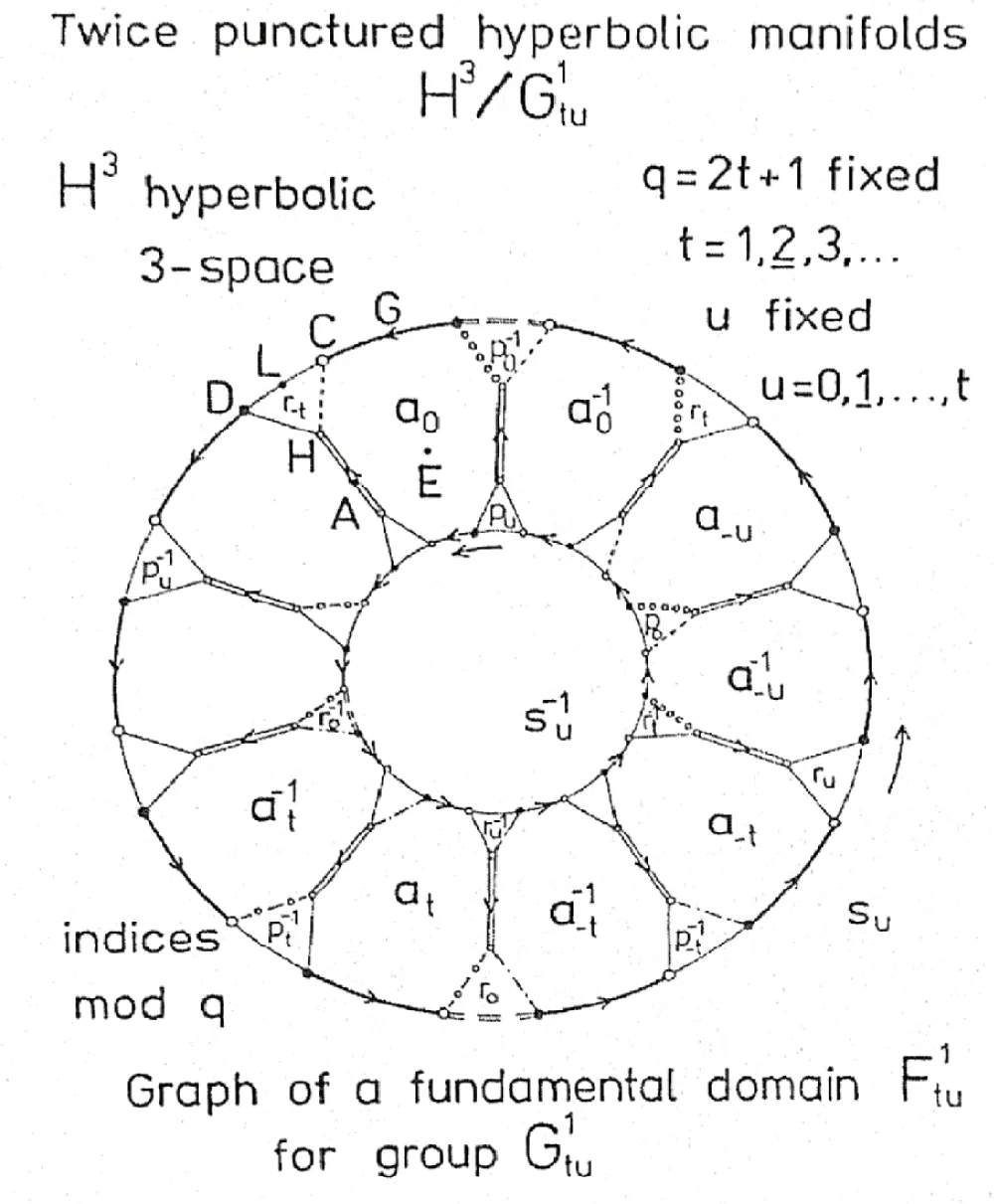
2.1. Fundamental domain series F1tu of groups G1tu in hyperbolic space H3
Generators: ai (-t ≤ i ≤ +t): ai-1 → ai glide reflections --- pi (-t ≤ i ≤ +t): pi-1 → pi screw motions --- ri (-t ≤ i ≤ +t): ri-1 → ri screw motions ---
su(0 ≤ u ≤ t with fixed u): su-1 → su a unique screw motion --- Altogether, there are 3q + 1 = 6t + 4 generators.
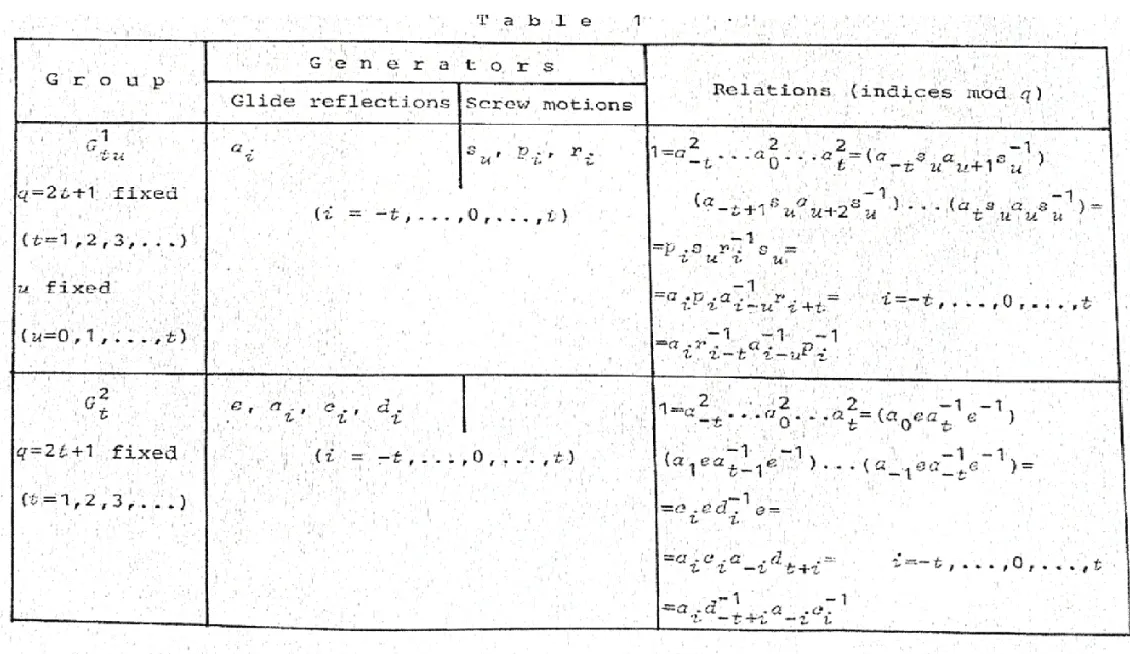
Relations are represented by arrowed edges in Table 1:
e.g. Þ a-ta-t…a0a0…a+ta+t=1 identity; --- e.g.ooo> a0p0a-u-1 rt = 1
The equivalence classes C (Cu) and D (Cl) are reflections centres with half ball neighbourhoods, i.e., punctures for quantum dots.
The other point classes (orbits, e.g. for G, E, A, H, L, … for occasional Si atoms (ions)) have ball neighbourhoods, as at manifolds.
The proportions depend on parameter q = 2t + 1. We have infinitely many hyperbolic possibilities. The minimal one with t = 1, q = 3 is
potentially significant for experimental realization. For instance, it follows in case q = 3, u = 0 on the base of Table 1:
G110 = {a-1, a0, a1; s0 =: s, p-1, p0, p1, r-1, r0, r1 -- 1 = a-12a02a12 = (a-1sa1s-1)(a0sa-1s-1)(a1sa0s-1)
= (p-1sr-1-1s) = (p0sr0-1s) = (p1sr1-1s)
= (a-1p-1a-1-1r0) = (a0p0a0-1r1) = (a1p1a1-1r-1)
= (a-1r1-1a-1-1p-1-1) = (a0r-1-1a0-1p0-1) = (a1r0-1a1-1p1-1)}
with trigonal rotational symmetric fundamental domain.
Remark. It was a tedious work, with lengthy computations in our original paper [1] that both points C and D have fixing point reflections. Extra group computation was, how to derive this from the presentation of G110 in Table 1 (This can be verified using the above example).
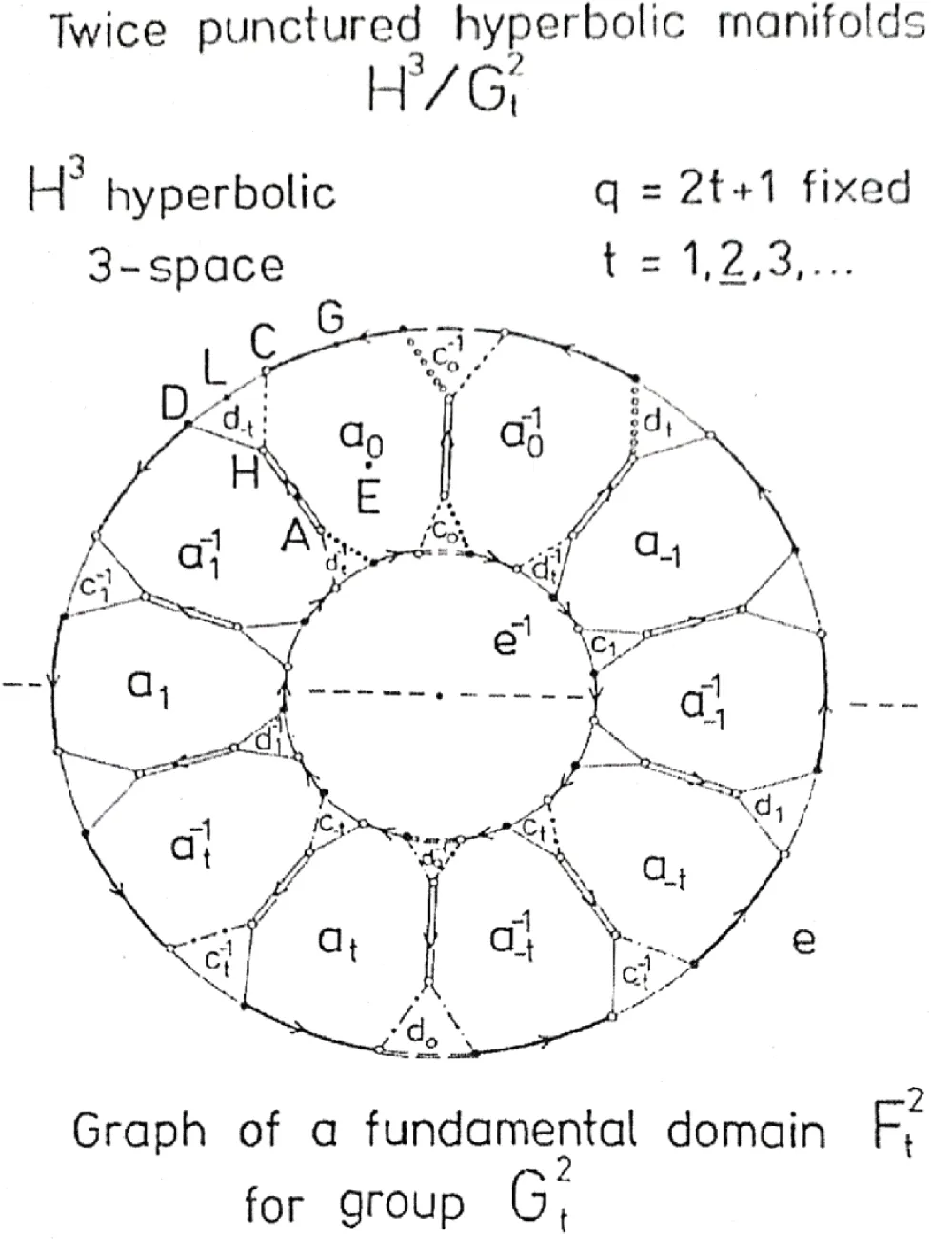
2.2. Fundamental domain series F2t of G2t (u = 0) in H3
Generators: ai(-t ≤ i ≤ +t): ai-1 → ai glide reflections --- ci (-t ≤ i ≤ +t) : ci-1 → ci glide reflections --- di (-t ≤ i ≤ +t): di-1 → di glide reflections---
e (0 ≤ u ≤ t, for simplicity, u = 0 is fixed to obtain a unique case) glide reflection --- Altogether: 3q + 1 = 6t + 4 generators.
Relations are collected to arrowed edges in Table 1:
e.g. ⇒ a-ta-t…a0a0…a+ta+t = 1 identity; --- e.g. ooo> a0c0a0-1dt = 1.
The equivalence classes C (Cu) and D (Cl) are reflection centres with half ball neighbourhoods, i.e., punctures for quantum dots.
An integer parameter u with 0 ≤ u ≤ t can be introduced for other (non-isometric) manifolds, similarly as before.
The (projective) metric, i.e. Beltrami-Cayley-Klein (B-C-K) model, is introduced later for Bolyai - Lobachevsky hyperbolic geometry!
Then we can compute all angle and distance data of the above and following (congruent for equal t-s) fundamental domains.
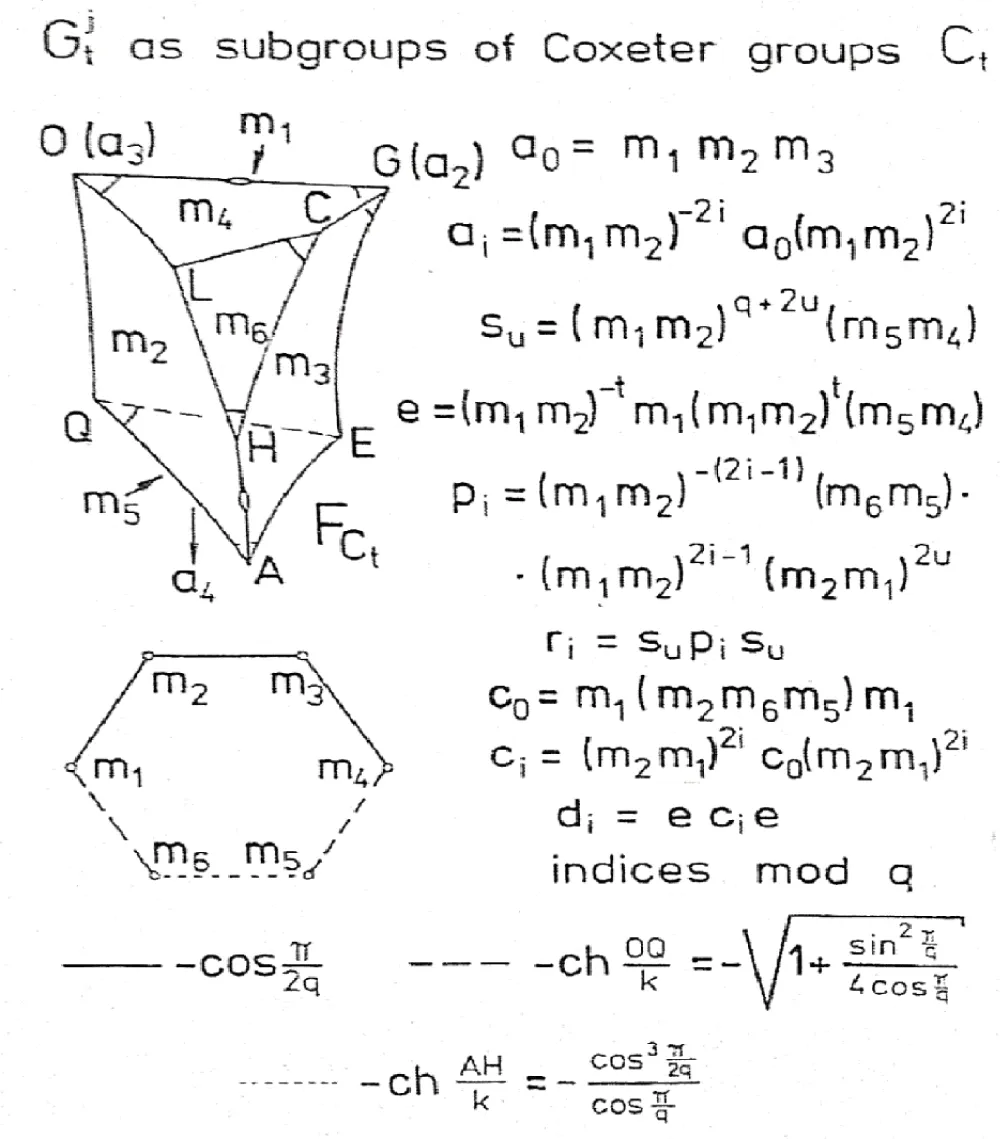
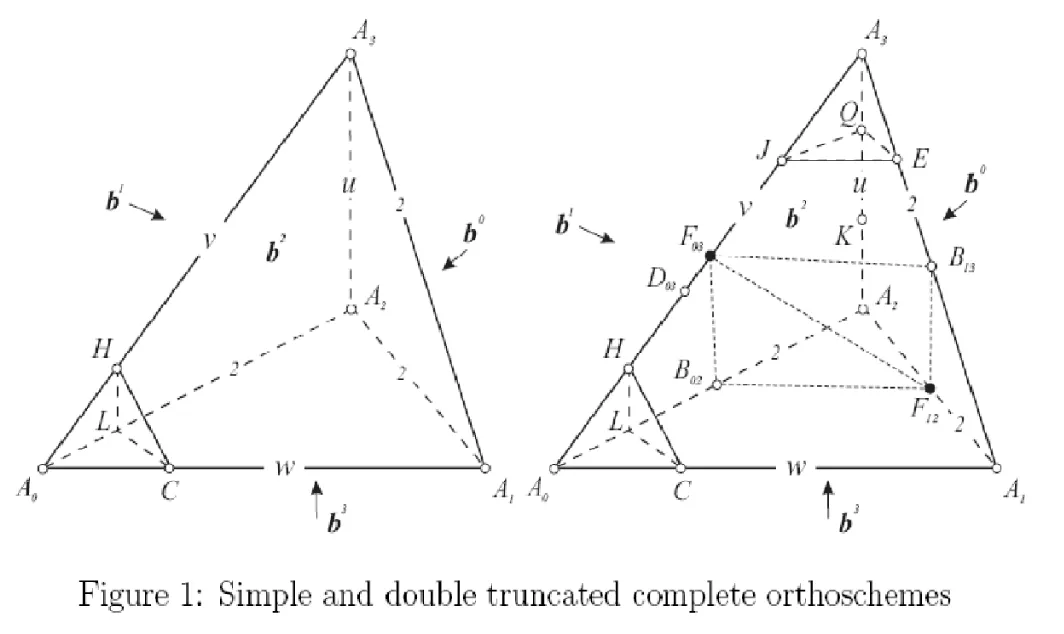
2.3. Reflection group Ct and its fundamental domain in H3 as truncated orthoscheme; hints to B-C-K model of H3, generators for previous G1u and G2t; some distances for Coxeter diagram, sketch.
The orthoscheme projective coordinate simplex A0A1A2A3 ~ b0b1b2b3 will be described in the real (left) vector 4-space V4 (for points X (where X = XiAᵢ ~ cX) and its dual (right) form space V4 (for planes u(u = bjuj ~ uc); Aibj = Aibj (Kronecker symbol).
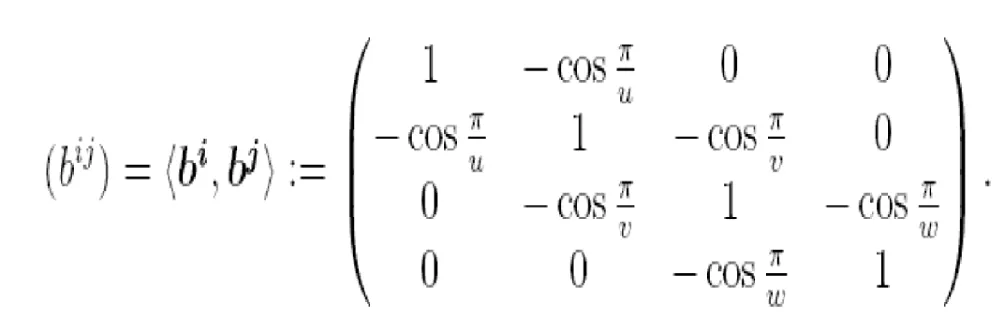
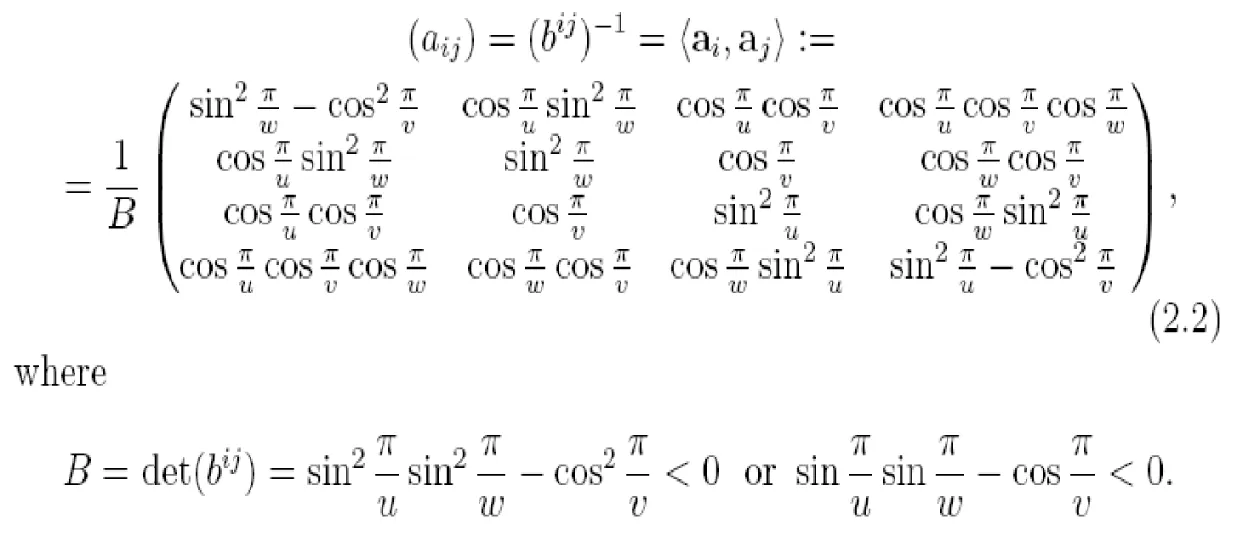
By the symmetric Coxeter– Schläfli (C–Sch) matrix (bij) = <bi, bj> = (cos(π – βij))
first for angles βij = (ㄥbibj) with (ㄥbibi) = π, as is standard; then for distances by the inverse (bij)-1 =: (Aij) =: <Ai, Aj>, so
cosh(XY/k) = – <X, Y>/(<X, X><Y, Y>)½
is the distance of points X and Y. Here k = (-1/K)1/2 is the universal unit distance of the hyperbolic space H3, K is the constant negative sectional curvature.
In nano size k must be determined (measured). The Periodic Table of the Elements gives important information by relative atomic weights, then consequently atomic radii! Further mathematical details are provided in the References, e.g. [1-9].
In our next Figure (from the original paper [1]) the doubly truncated orthoscheme comes from the A0A1A2A3 = b0b1b2b3 coordinate simplex (see also later Figure 3, 1), but here we used the previous notations of paper [1]: A2 → a3 for point O, A1 → a2 for point G, A3 → a4 for outer point A3, whose polar plane a3 is m5 here, A0 is outer point whose polar plane a0 is denoted by m6 here. The simplex planes b0, b1, b2, b3 are denoted by m1, m2, m3, m4 now.
2.4. Table 1: Presentations of fundamental groups G1tu and G2t by generators and defining relations to previous figures.
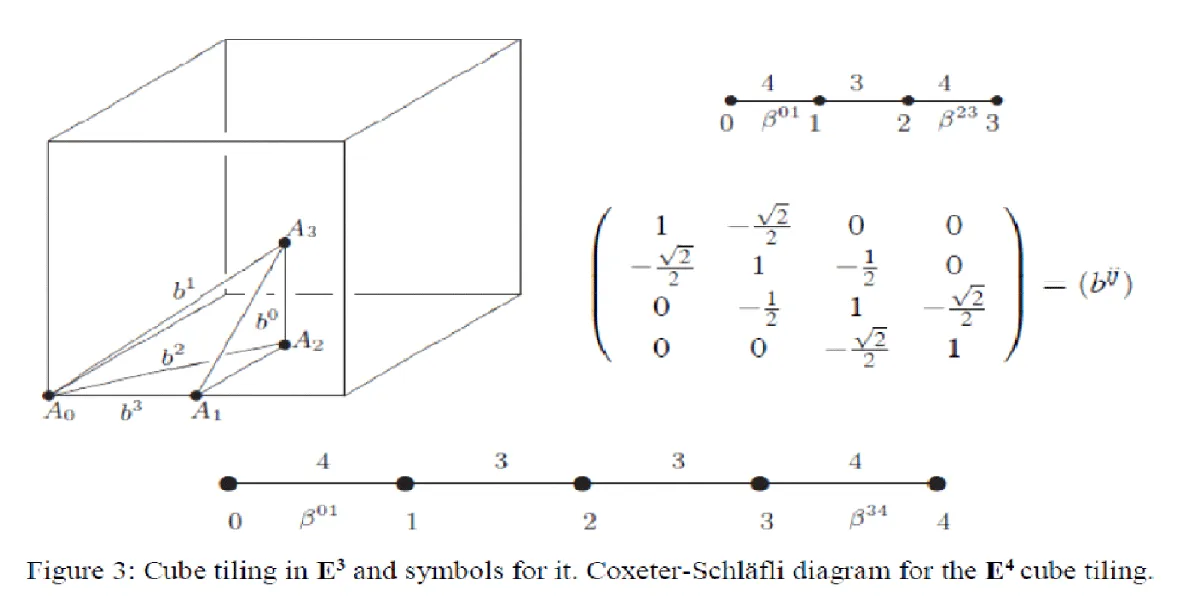
3. The Euclidean cube tiling and its characteristic orthoscheme (4, 3, 4), C-Sch diagram, matrix (illustration for later analogous hyperbolic projective metric)
The matrix (bij) in the next figure is of signature (+, +, +, 0) indeed for euclidicity. Then the signature depends on parameters u, v, w = u, as crucial. For hyperbolicity (+, +, +, –) is necessary later on [10,11].
3.1. C-Sch matrix and its inverse for orthoscheme (u, v, w(=u)) and for “trunc-simplices”. scalar products for forms (planes) and vectors (points)
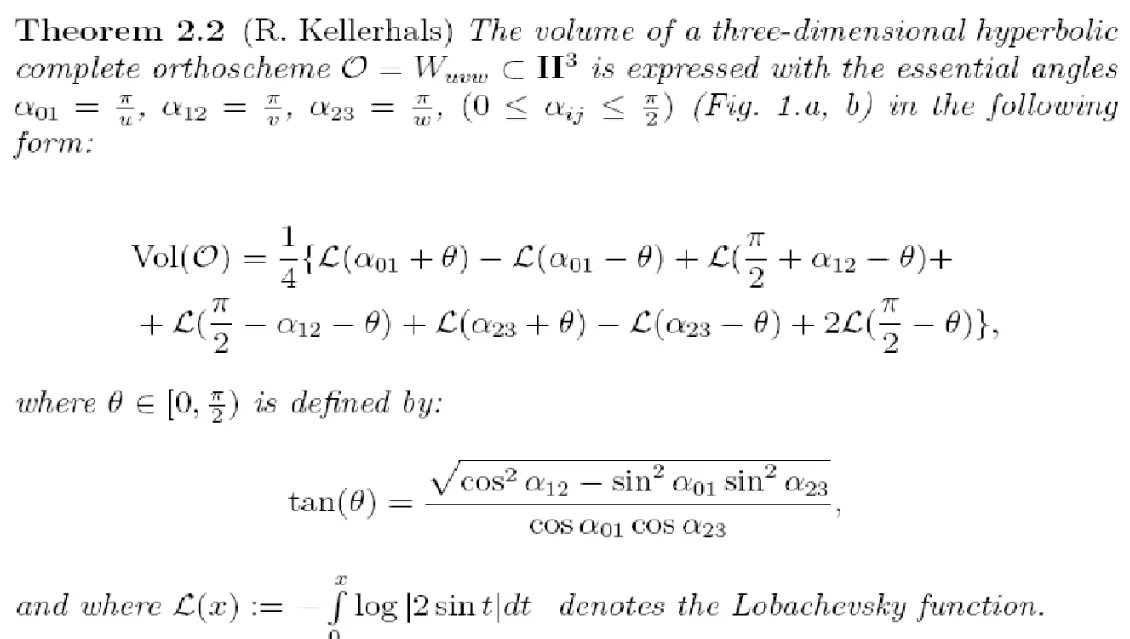
3.2. The volume of the orthoscheme by N. I. Lobachevsky’s ideas with generalisation of R. Kellerhals
3.3. The football polyhedron {5, 6, 6} from the half orthoscheme (5, 3, 5)
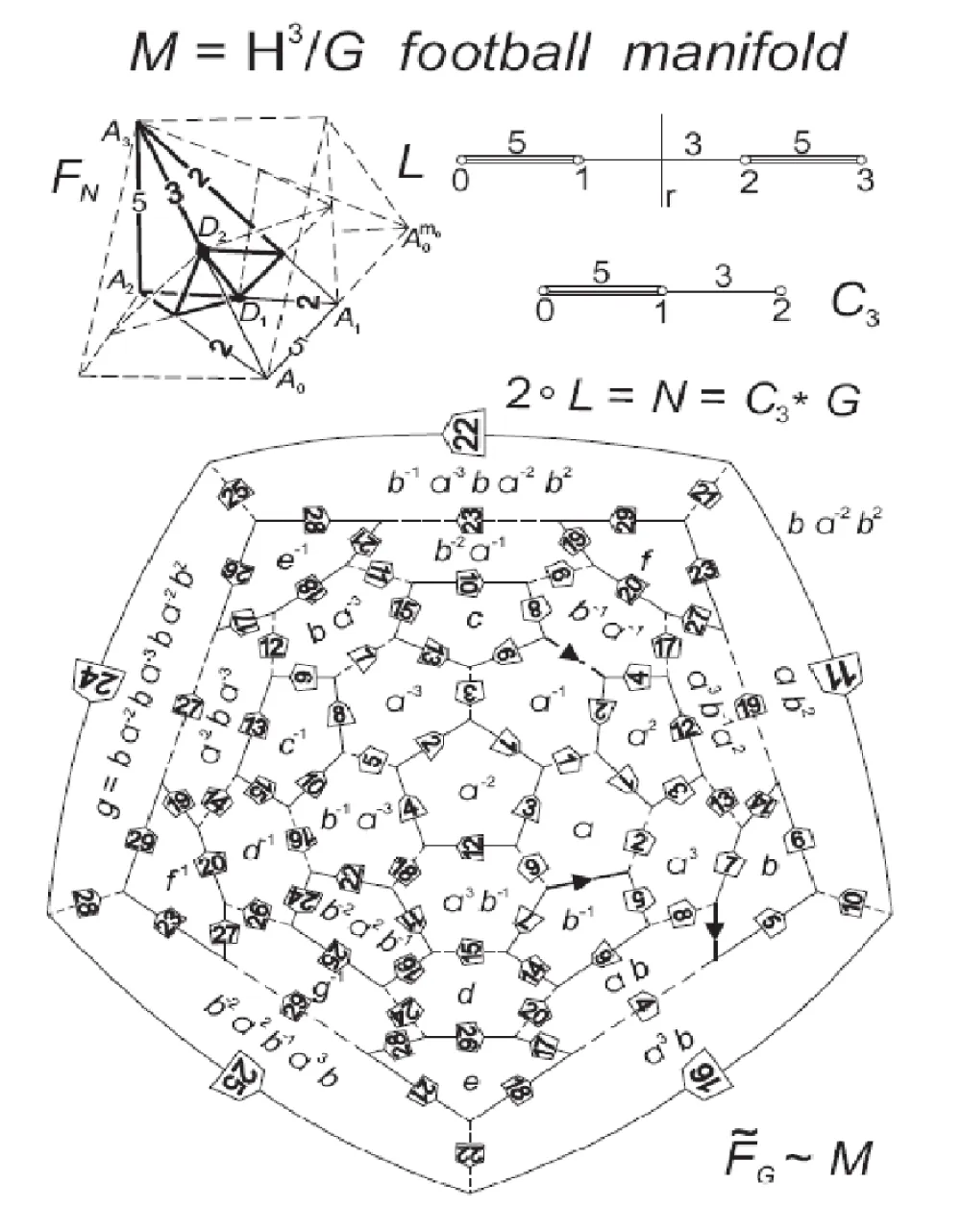
For "hyperbolic football" u = w = 5, v = 3, the signature of the C-Sch matrix is (+, +, +, –), indeed. The 3 -➤- arrows determine the face pairing generators a: a-1 → a and b: b-1 → b and the product ab.
E. Molnár, Two hyperbolic football manifolds. In: Proceedings of International Conference on Differential Geometry and Its Applications, Dubrovnik Yugoslavia, 1988. 217–241.
E. Molnár, On non-Euclidean crystallography, some football manifolds, Struct Chem (2012) 23:1057–1069.
4. Construction of orientable cobweb (or tube) manifold series for visualisation from half trunc-orthoscheme, by 2z = u = v = w ≧ 6
Trunc-simplex (u, v, w = u) with (1/u) + (1/v) < ½; then A0 and A3 are outer vertices with truncating polar planes a0 resp. a3
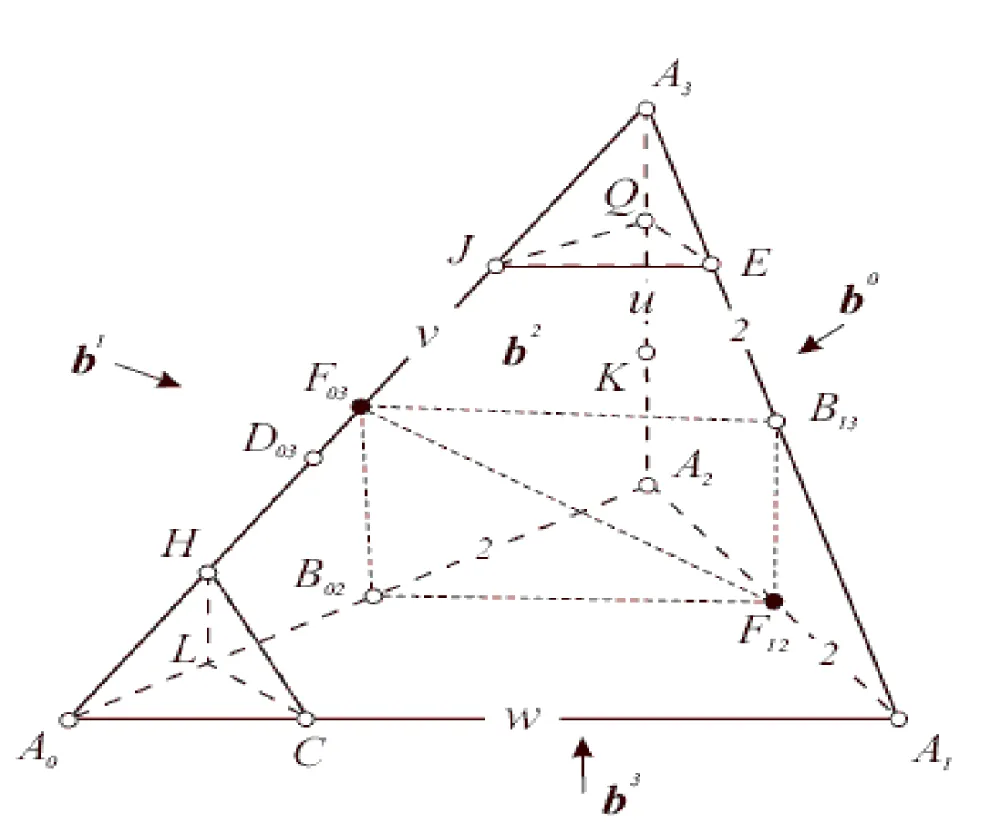
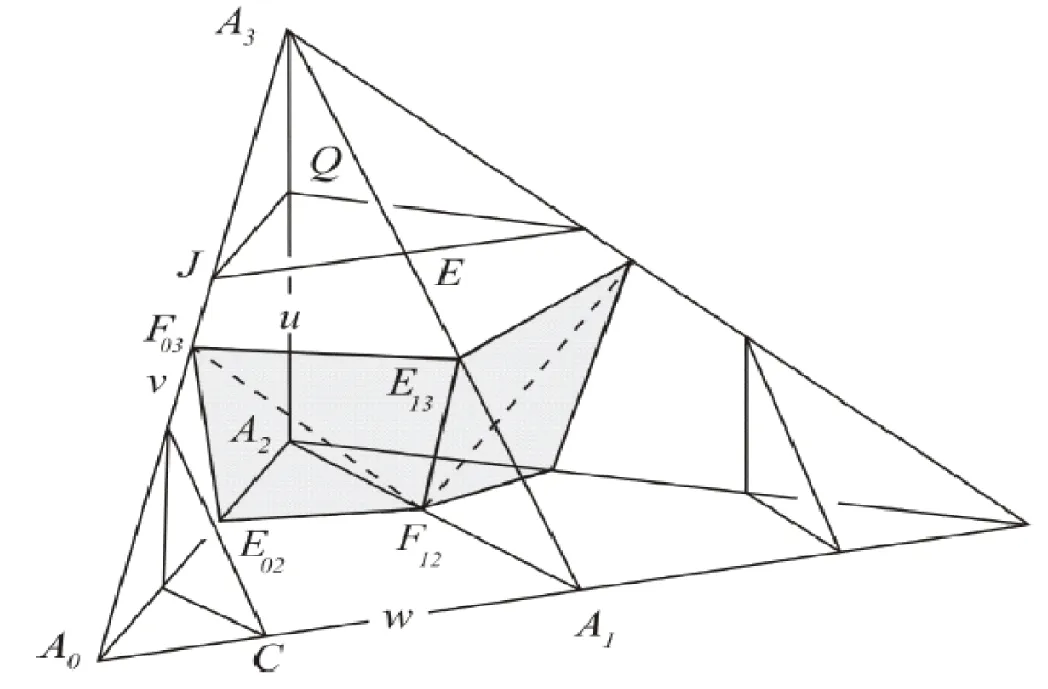
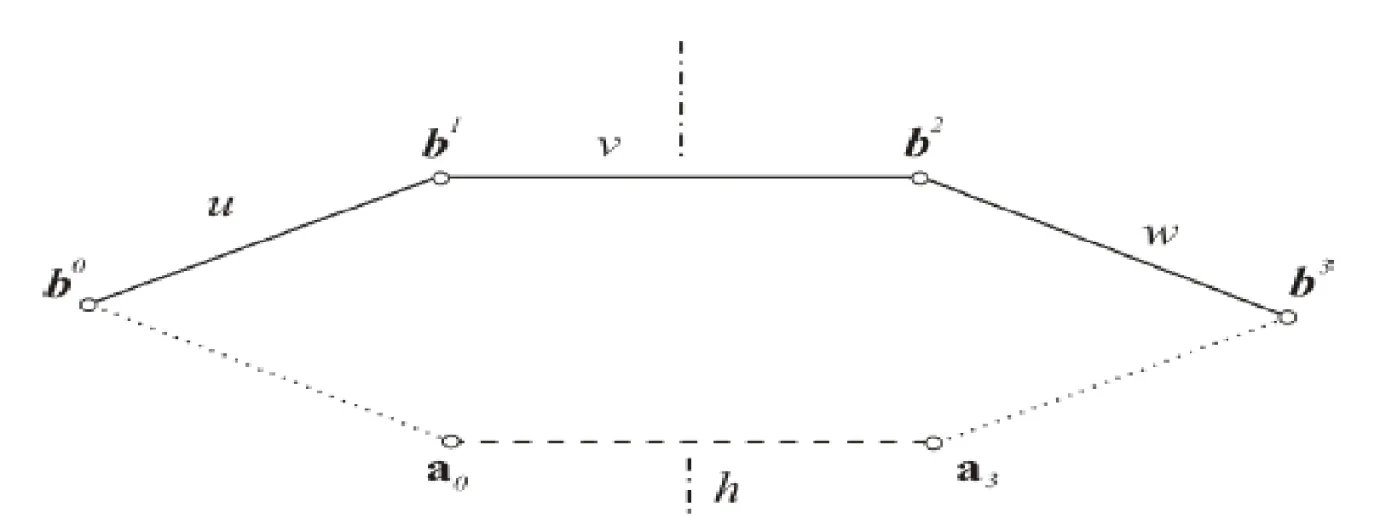
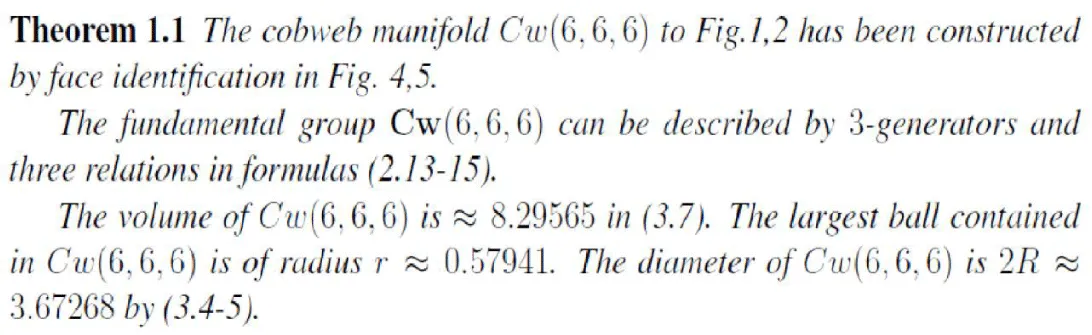
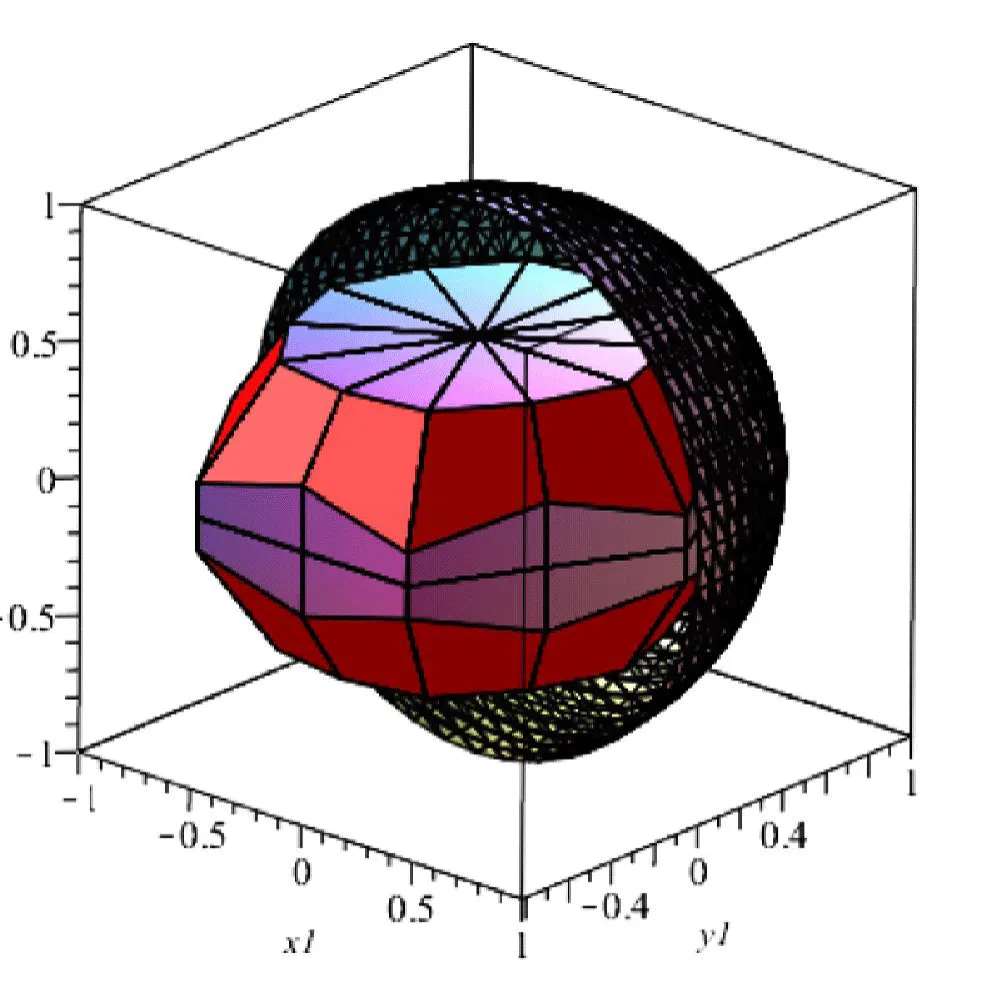
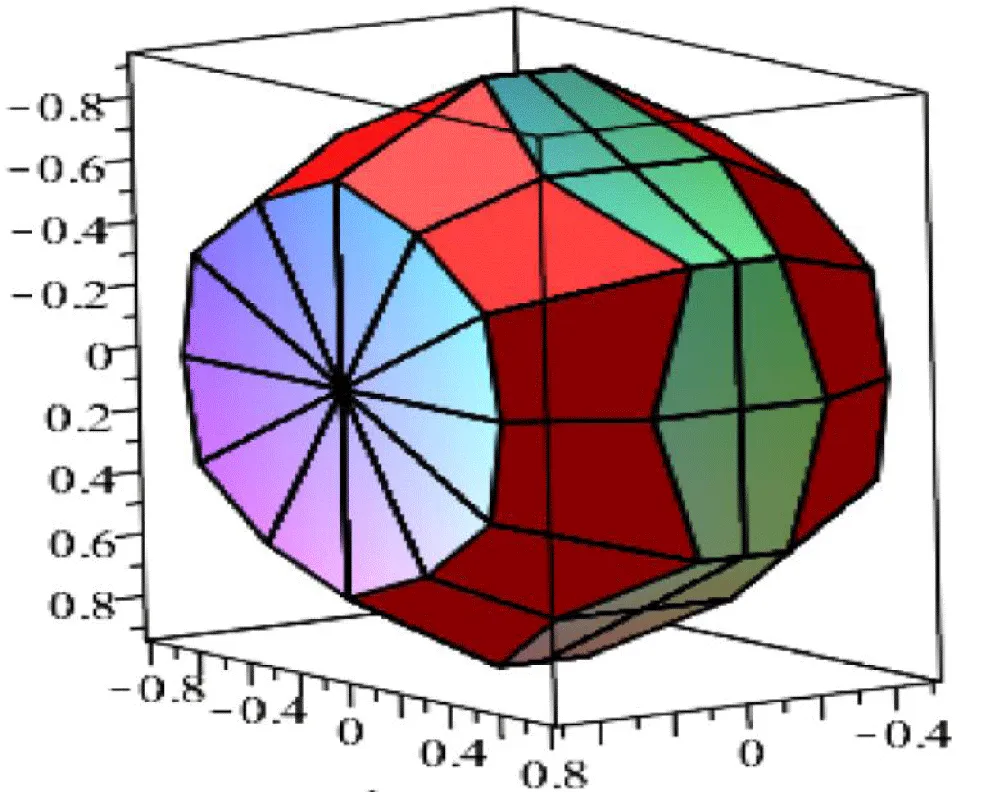
4.1. Construction of cobweb (tube) manifold Cw(6) by complex face-pairing identifications from D-V cell of previous point Q
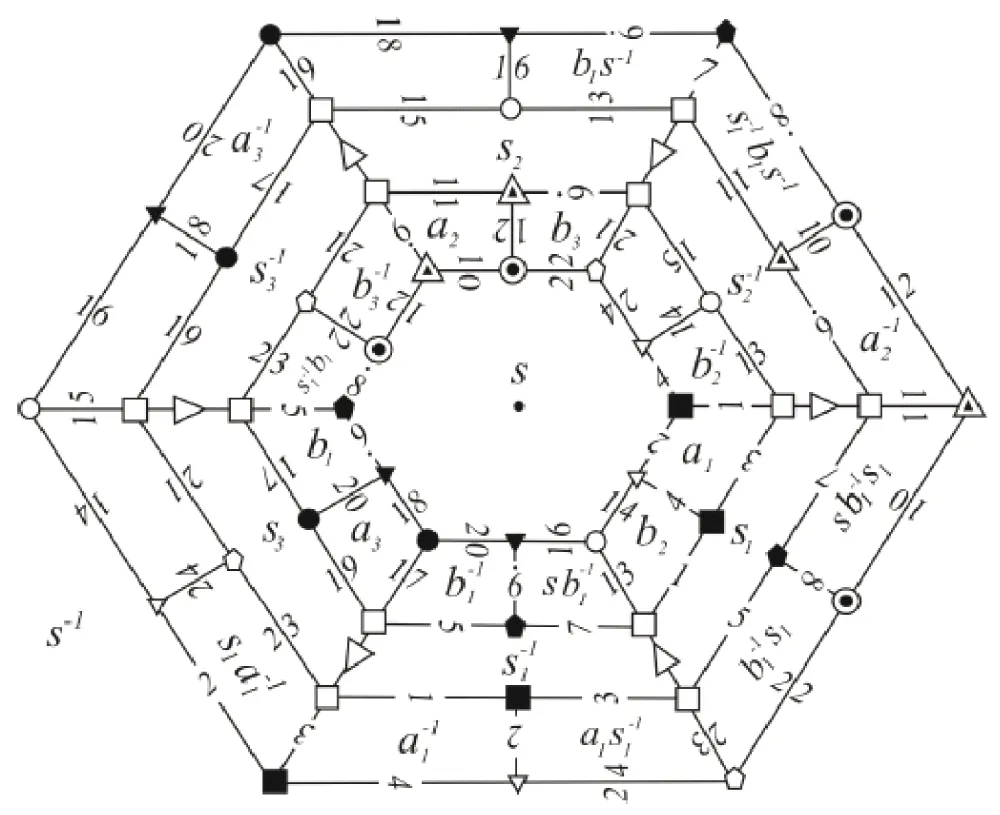
4.2. Images from the animation of cobweb (tube) manifolds Cw(6) in B-C-K model of H3
Acknowledgement
The author thanks his colleagues Dr. István PROK and Dr. Jenő SZIRMAI for scientific collaborations, to Dr. Ede BENDE and Acad. István HARGITTAI for Chemistry consultations, to Dr. Jenő SZIRMAI for assistance in preparation of this presentation.
I gratefully acknowledge Prof. Dr. János SZENTHE (1933-2023) who was my Master in differential geometry, inspiring and supporting my publications [1], [2], [3].
Appendix
New infinite series of non-orientable hyperbolic space forms as the original intention
Tis section explains how the earlier issue was resolved, and obtain from twice punctured manifold series a non-orientable manifold series by modified face identifications. Indeed, only orbits C and D need to be merged, to get a ball-like neighbourhood for C = D orbit.
Changing the face identifications: screw motions p, r to glide reflections c, d (respectively) in G1tu, so C = D is glued together, we obtain non-orientable space form [3].
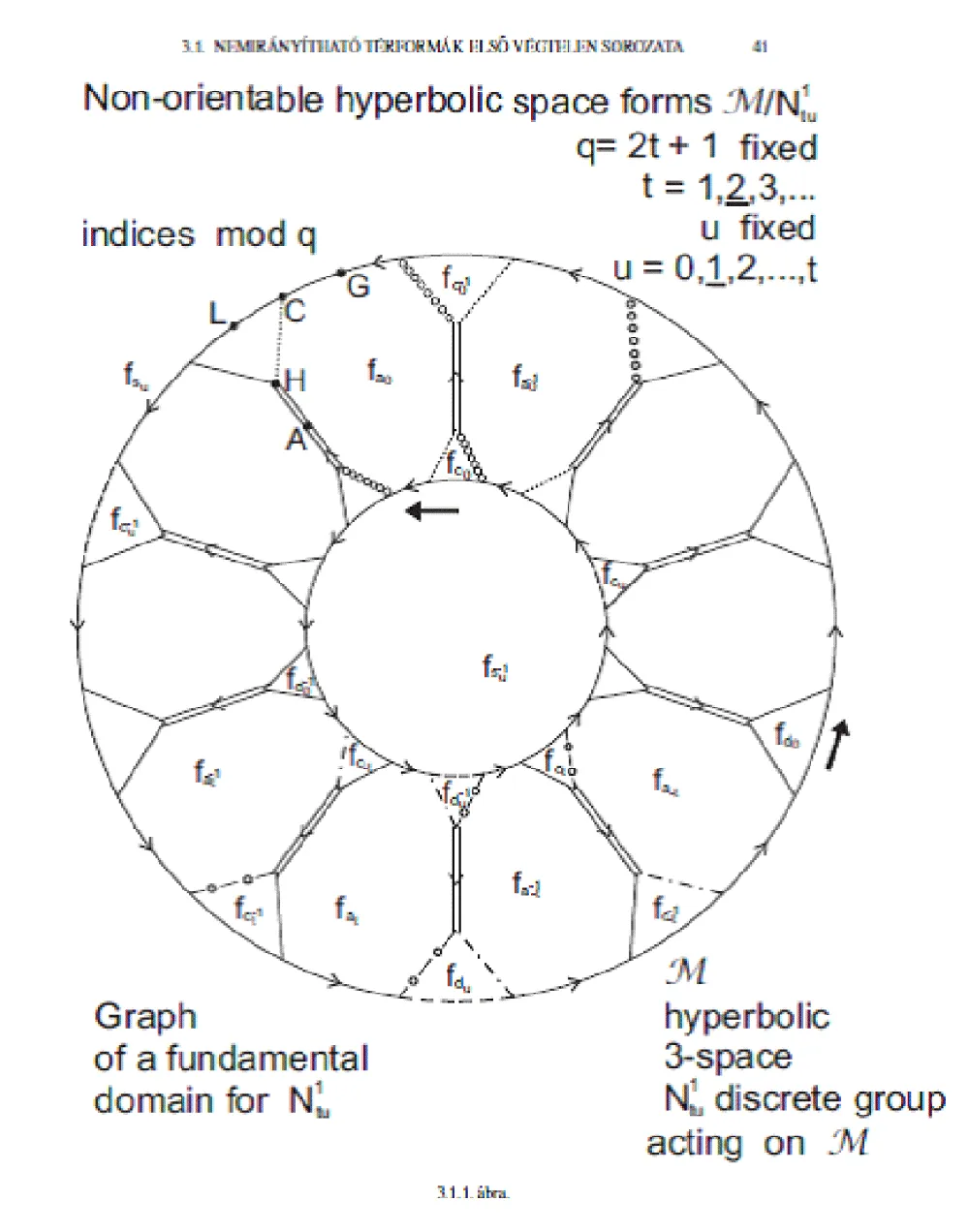
M /N1tu (M = H3). Compare with the former H3/G1tu ( Here C = D)
Similarly, changing glide reflections c, d to screw motions p, r in G2t , so C = D is glued together, we obtain non-orientable space form t M /N2t (Here M = H3).
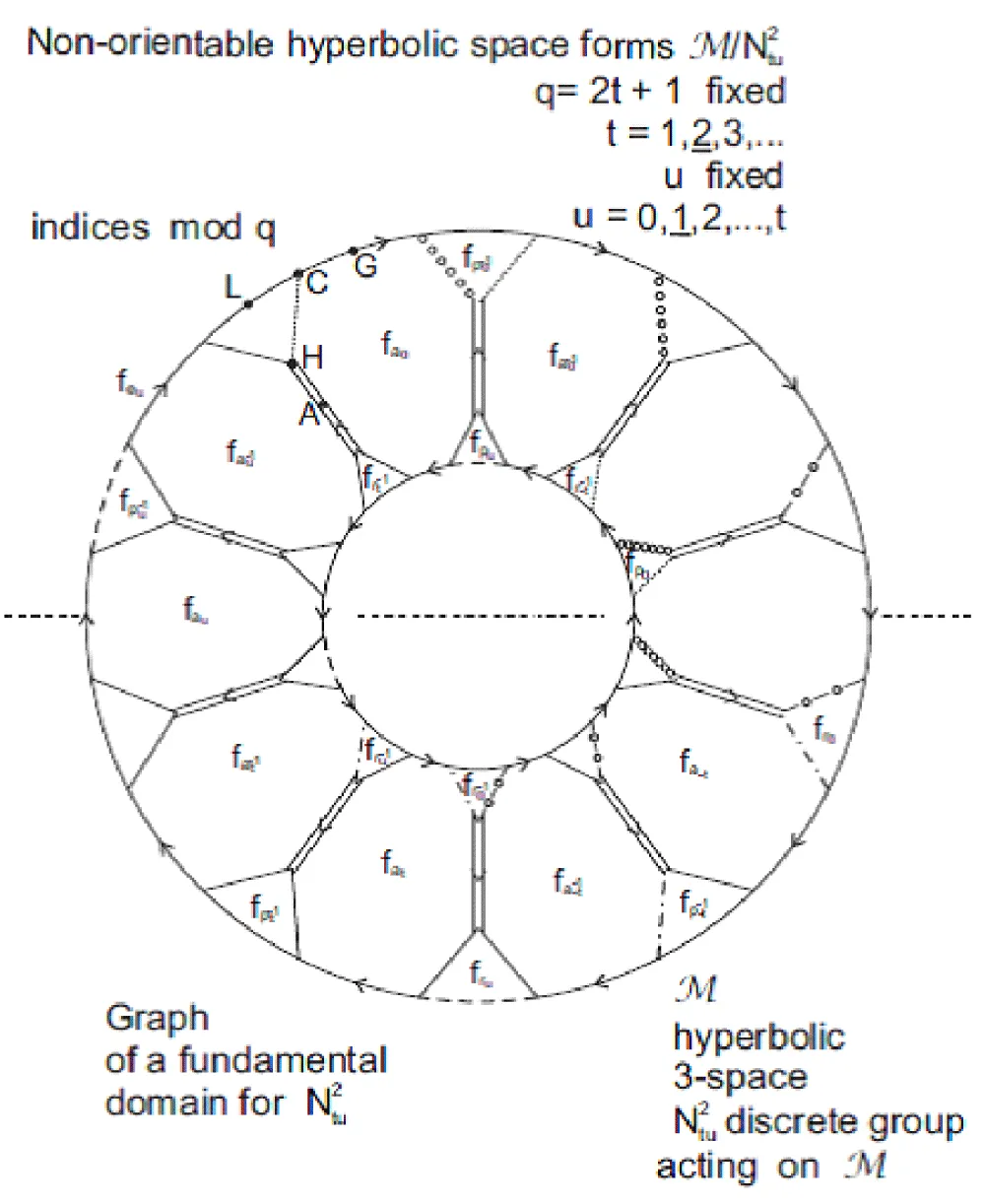
Compare with the former H3/Gt2 (Here C = D)
Table 2: The algorithmic fundamental group presentations of our non-orientable manifold series and of their orientable twofold covering groups Gt (in Hungarian from [3], but as before in Table 1).
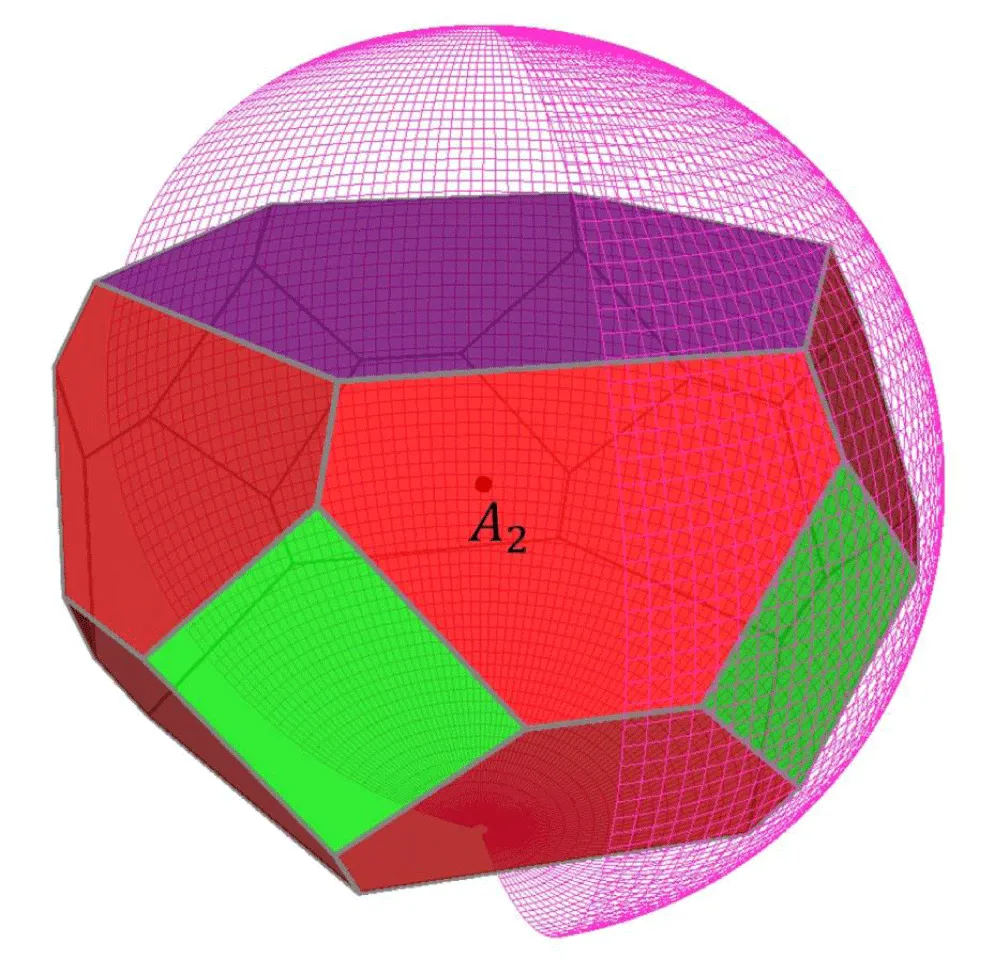
Another fundamental domain with trigonal rotation symmetry with other presentations (the figure constructed as a fine D-V cell by our Indonesian doctor student (now PhD) Arnasli Yahya)
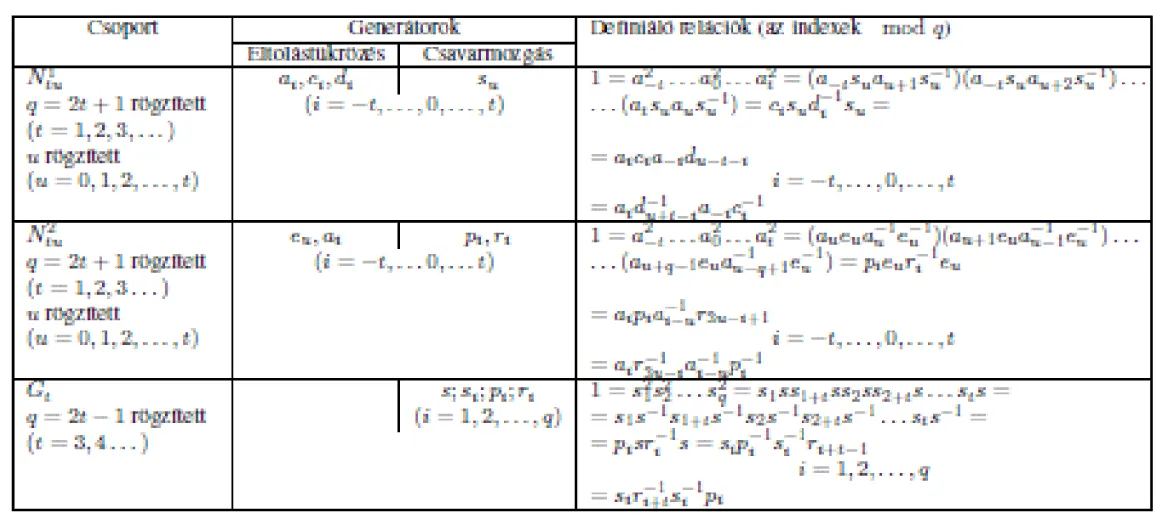
Our analogous non-orientable manifold fundamental group series N1tu and N2tu and their orientable twofold covering group series Gt
Of course, the reader needs more detailed explanations. Thus we (with Jenő Szirmai and Arnasli Yahya) turn back to the topic in a revisited mathematical paper.
References
- Molnár E. Twice punctured compact Euclidean and hyperbolic manifolds and their twofold coverings. In: Topics in Differential Geometry. Colloquia Math Soc J Bolyai. Debrecen (Hungary); 1987. p. 883–919. Available from: https://www.academia.edu/129079299/Twice_punctured_Euclidean_and_hyperbolic_manifolds_revisited_as_hypothetical_explanation_for_quantum_dots_40_years_old_Honour_to_the_Laureates_of_Chemistry_Nobel_Prize_2023_and_also_to_the_200th_Anniversary_of_János_Bolyais_Absolute_Geometry_in_Hungarian_
- Molnár E. An infinite series of compact non-orientable 3-dimensional space forms of constant negative curvature. Ann Glob Anal Geom. 1983;1(3):37–49. Erratum in: Ann Glob Anal Geom. 1984;2(2):253–254. Available from: https://www.academia.edu/164595867/An_infinite_series_of_compact_non_orientable_3_dimensional_space_forms_of_constant_negative_curvature
- Molnár E. Polyhedron models of discrete groups and space forms [habilitation dissertation]. Budapest: Budapest University of Technology and Economics, Institute of Mathematics; 1995. Hungarian.
- Hahn T, editor. International tables for crystallography. Vol. A: Space-group symmetry. 1st ed. 1983; 5th ed. 2002; Corr. reprint 2005. Wondratschek H, Müller U, editors. Vol. A1: Symmetry relations between space groups. 1st ed. 2004.
- The Royal Swedish Academy of Sciences. The Nobel Prize in Chemistry 2023: press release; 2023 Oct 4. Available from: https://www.nobelprize.org/prizes/chemistry/2023/press-release/
- Molnár E. On non-Euclidean crystallography, some football manifolds. Struct Chem. 2012;23(4):1057–1069.
- Molnár E, Szirmai J. Symmetries in the 8 homogeneous 3-geometries. Symmetry Cult Sci. 2010;21(1–3):87–117. Available from: https://www.researchgate.net/publication/265586473_Symmetries_in_the_8_homogeneous_3-geometries
- Molnár E, Szirmai J. Infinite series of compact hyperbolic manifolds as possible crystal structures. Mat Vesnik. 2020;72(3):257–272. Available from: https://arxiv.org/abs/1711.09799
- Molnár E, Szirmai J. Dense ball packings by tube manifolds as new models for hyperbolic crystallography. Mat Vesnik. 2024;76(1–2):118–135. Available from: https://arxiv.org/abs/2309.15168
- Vinberg EB, editor. Geometry II: spaces of constant curvature. Berlin: Springer-Verlag; 1993. Available from: https://link.springer.com/book/10.1007/978-3-662-02901-5
- Wolf JA. Spaces of constant curvature. New York: McGraw-Hill; 1967. Russian translation: Moscow: Nauka; 1982. Available from: https://books.google.co.in/books/about/Spaces_of_Constant_Curvature.html?id=8qoJBAAAQBAJ&redir_esc=y
Advertisement


 Save to Mendeley