Annals of Mathematics and Physics
Research and Development of New Vibration and Noise Reduction Methods and their Manufacturing Technology
1Professor, Academy of Physical and Mathematical Sciences, Tbilisi, Georgia
2Bachelor of Science in Economics with Mathematical Concentration, Drexel University, Philadelphia, USA
Author and article information
Cite this as
Gavasheli L, Gavasheli A. Research and Development of New Vibration and Noise Reduction Methods and their Manufacturing Technology. Ann Math Phys. 2026;9(1):040-043. Available from: 10.17352/amp.000178
Copyright License
© 2026 Gavasheli L, et al. This is an open-access article distributed under the terms of the Creative Commons Attribution License, which permits unrestricted use, distribution, and reproduction in any medium, provided the original author and source are credited.Abstract
Based on the theoretical research conducted in our laboratory, a technology for producing new flexible-damping materials has been developed. These flexible-damping elements are characterized by an increased ability to absorb harmful energies and high resistance to cyclic loads, while under static and dynamic loads, their 'stress-displacement' behavior exhibits a hysteresis characteristic in a hyperbolic form. These advantages of flexible-damping elements allow them to be effectively used in the production of vibration- damping devices for heavy machinery, where vibration levels often exceed permissible limits, especially when operating in harsh environmental conditions.
Introduction
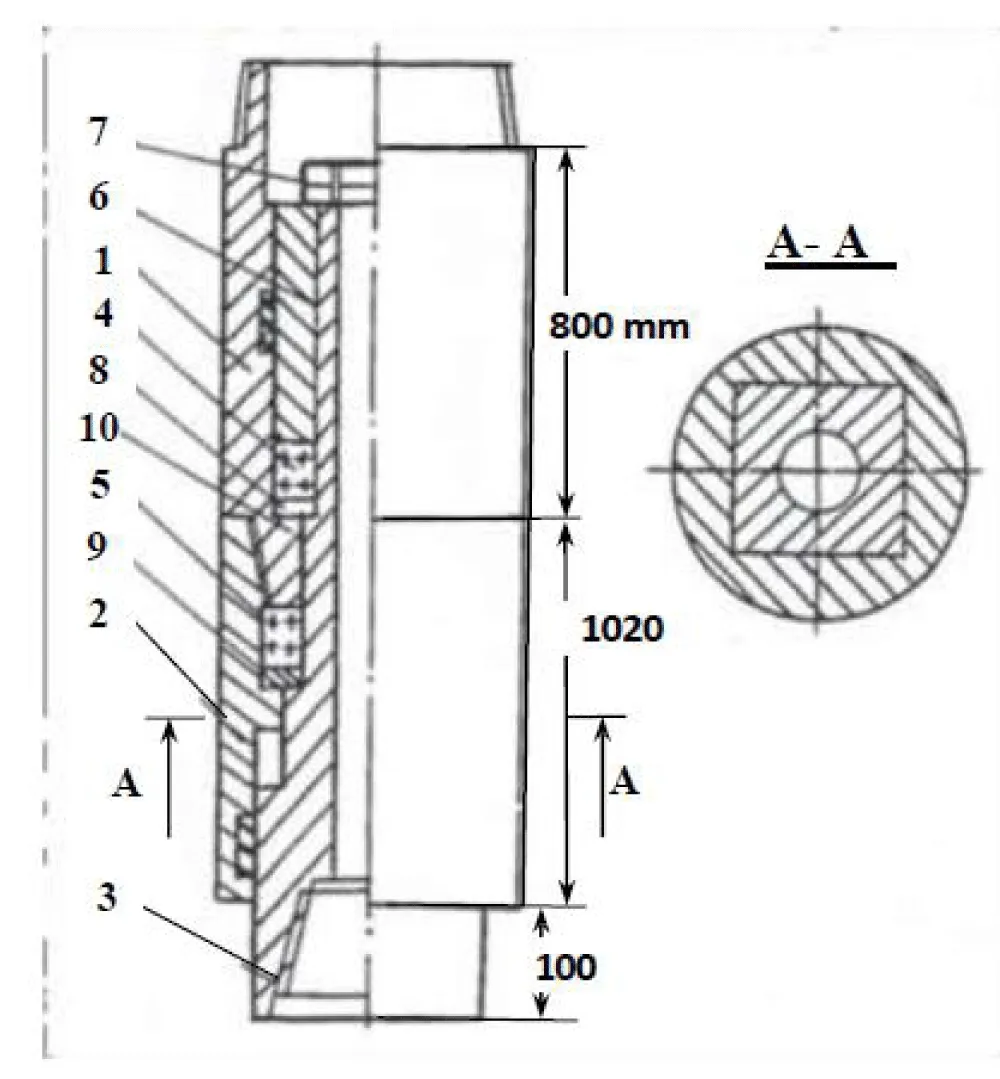
Presented by us is the design of one type of top-down shock absorber, which is shown in Figure 1. The top-down shock absorber is used for the effective vibration protection of heavy drilling machines and their mechanisms [1]. The top-down shock absorber consists of the following parts: detachable upper (1) and lower (2) parts of the housing, drive shaft (3), upper (4) and lower (5) parts of the flexible damping element, support tube (6), yoke (7), upper (8) and lower (9) connectors, and the expanded end part of the shaft (10). During the operation of the shock absorber, the acting external stress is calculated using the formula
Where P0 - there is axial load, q × l - its own weight, (ml) and l × P1 components of the centrifugal force, n- is the number of cyclic loads.
Parts: 3 - drive cam; 4 and 5 - upper and lower elements of the flexible damping element; 6 support tube; 7-lever; 8 and 9 - upper and lower couplings; 10 - expanded end of the cam. The critical value of angular velocity generated during loading is calculated using the formula,
Where E is the modulus of elasticity of the vibration-damping material in dynamic mode. Based on theoretical research, a new technology for the production of elastic-damping materials has been developed. The mentioned elastic-damping elements used in this system are characterized by an increased ability to absorb harmful energies and high resistance to cyclic loads. For the transmission of torque, a square section is used on the shaft and the lower part of the housing, as shown in the first drawing with section A-A [2].
The operating principle of the vibration isolator is as follows: the axial load from the drill rig's drill pipe is transferred to the upper part of the housing 1, then through the upper flexible damping elements 4, as well as through the spindle 3 - to the lower flexible-damping elements 5 and through the lower part of the housing 2 to the main working part - the drilling tool. The upper 4 and lower 5 flexible-damping elements are pre-compressed with a certain force, which in turn prevents vibration shocks of the drilling tool and the entire system to the drilled rocks. Within the framework of the experiment, we determined the shape of the static cyclic loading unloading hysteresis loop of the flexible-damping elements, which is shown in Figure 2.
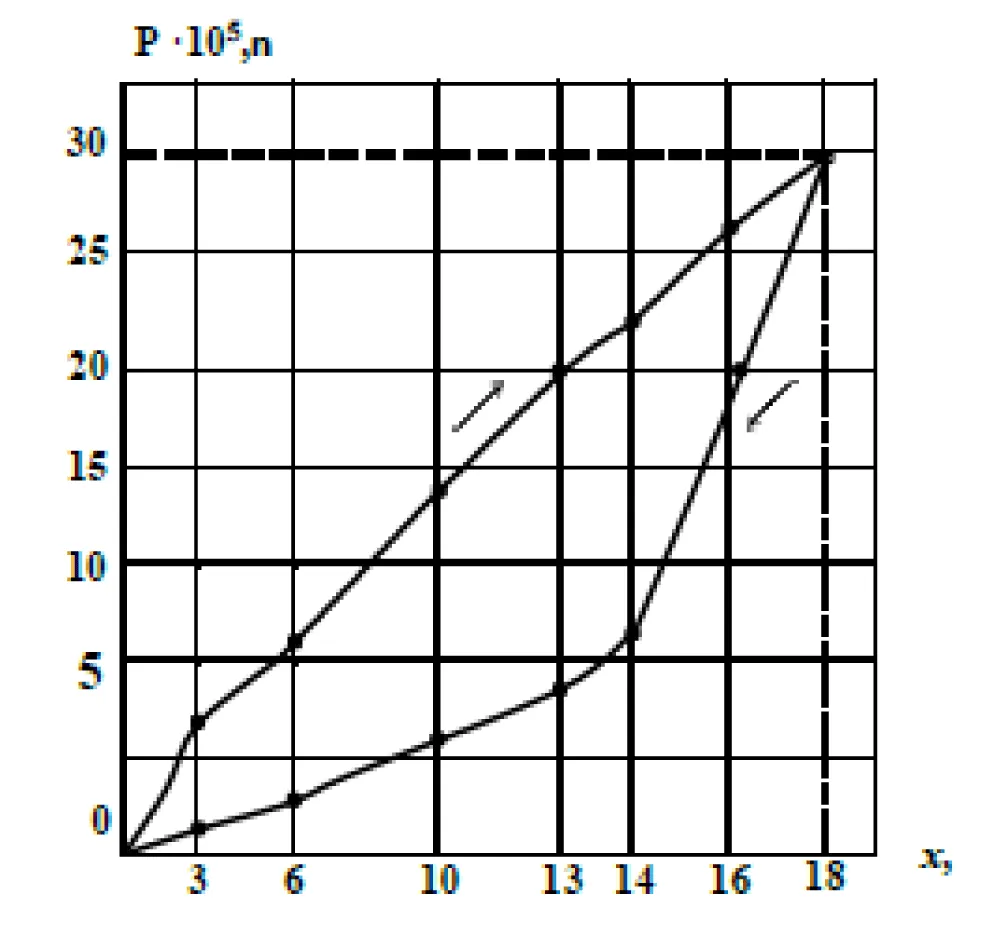
Simultaneously, we developed methodologies for determining the use of flexible-damping elements under operational conditions, their characteristics, and main working parameters, which make it possible to evaluate the service life and efficiency of flexible-damping elements under mandatory vibration conditions. The advantages of these flexible-damping elements allow them to be used in heavy machinery, specifically heavy drilling equipment with complicating factors, where the vibration levels significantly exceed permissible sanitary and hygienic standards, especially when operating in challenging environmental conditions, for the production of effective vibration protection solutions. Drilling equipment to determine and record the levels of mechanical forced vibrations and harmful vibrations of the drilling equipment, we used a field vibrometer and a vibration recorder (Danish company Brüel & Kjær). Piezoelectric accelerometers of the DH-3M1 type were mounted at the site of origin of the harmful vibrations, and their operating scheme is shown in Figure 3.
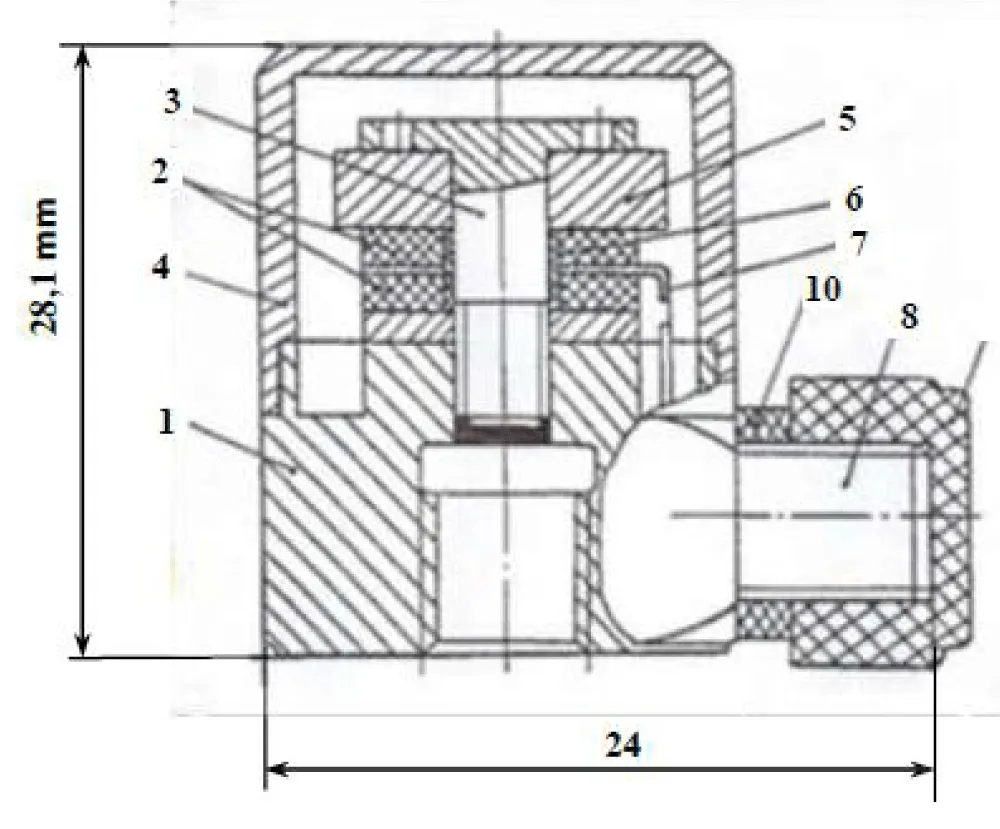
The operating principle of the piezoelectric accelerometer is as follows: a force P = ma, generated as a result of mechanical vibrations based on the piezoelectric effect, where a is the vibration acceleration and m is the inertial mass, causes deformation of the piezoelectric element, which results in electrical charges on the surface of the piezoelectric element. These charges are proportional to the force acting at a fixed moment and to the correspondingly generated vibration acceleration.
The operating frequency range of the piezoelectric accelerometer is calculated using the formula
where Cn - is the volumetric capacity of the vibro-generator, in farads; and C0 - is the voltage capacity within it, in farads,
where Rn - the electrical resistance of the vibrator, omi; R0 - the electrical resistance of the amplifier included in it, omi; n- cyclic deformation number [4].
Based on the analysis of experimental results, we determined that in the tested devices, the vibration level during the operation of the vibration damping means decreased on average by 12 – 14 dB in each vibration band, and the resonant frequency of the vibration damping means ranged between 120 – 125 Hz. The logarithmic levels of the vibration velocities are shown in Figures 4,5 [5].
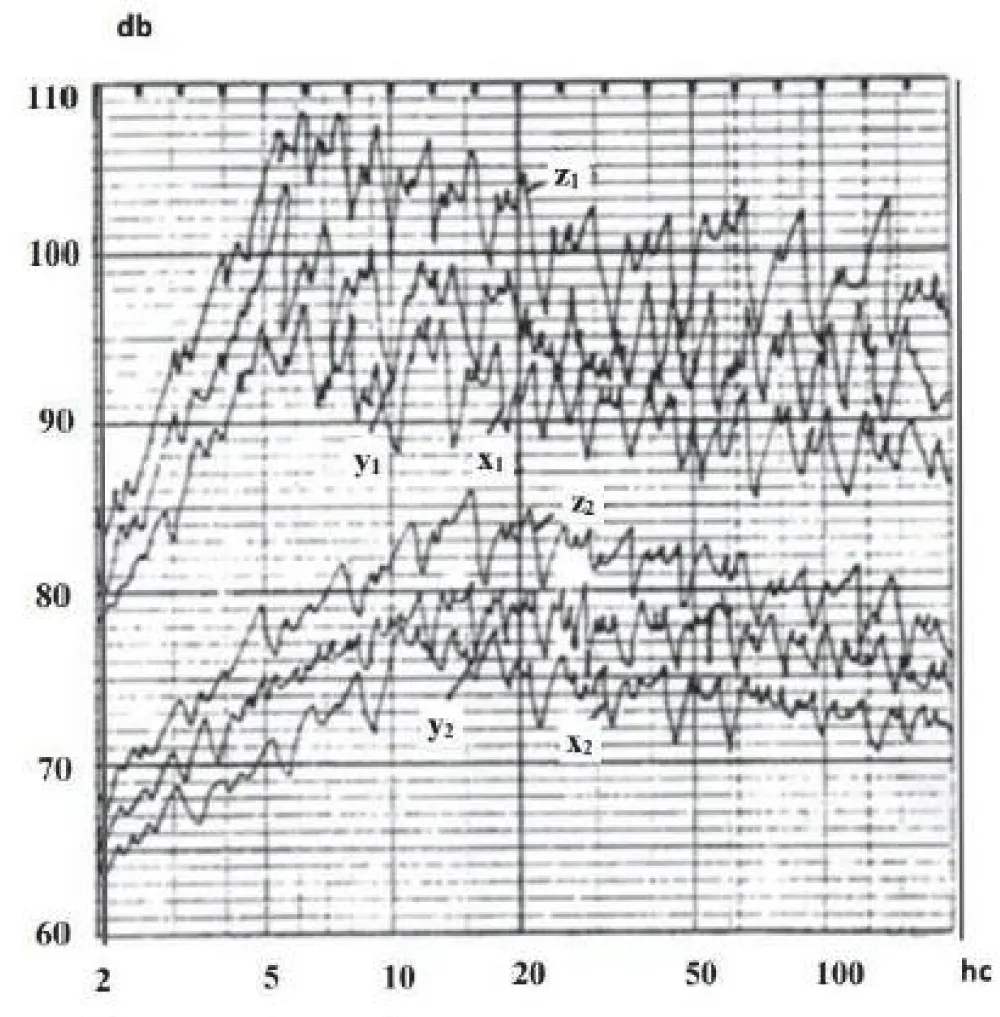
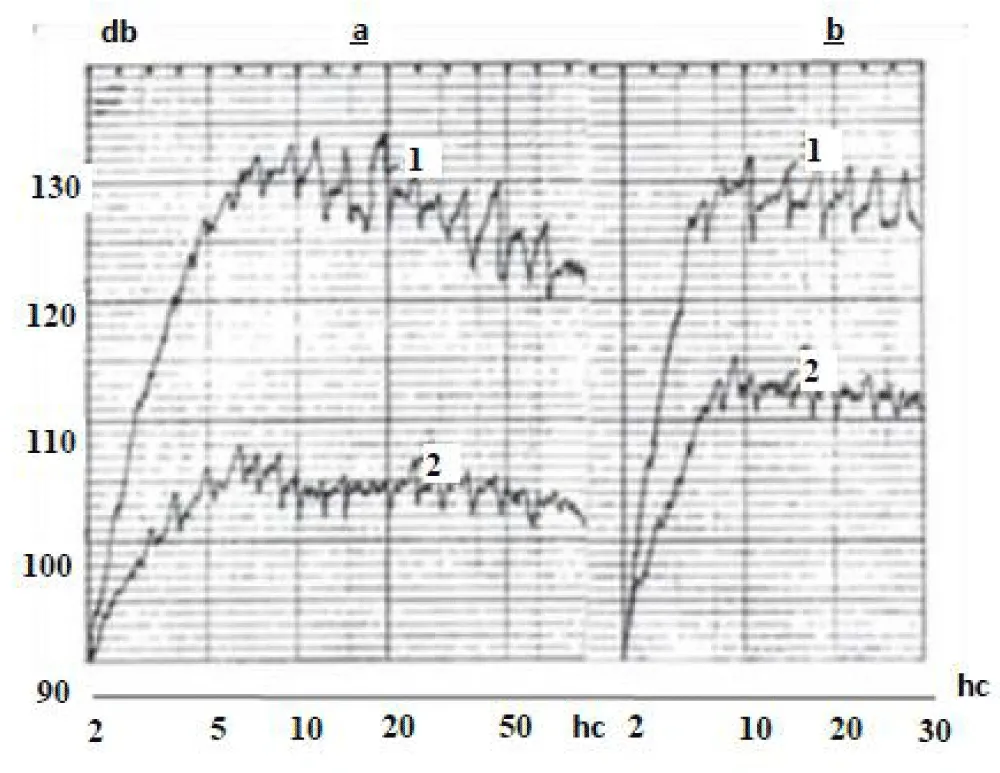
The logarithmic levels of vibration velocities at the operator's workplace of the equipment in octave bands withoutx1, y1, z1, and with the use of vibration damping devices x2, y2, z2 are presented in the Table 1.
Processing of experimental data obtained from numerous measurements when working with the vibration protection device shows that the dynamic loads on the working component of the mechanical system and on the operator's workplace are reduced and stabilized. In addition, the mechanical operation speed increases by 35% and the service life of the working component increases by 30%. These results are achieved due to the smooth and automatic adjustment of the stiffness of the elastic-damping element in the vibration protection device.
The mechanical model of the body of a seated machine operator with a vibration protection device is shown in the figure 6.
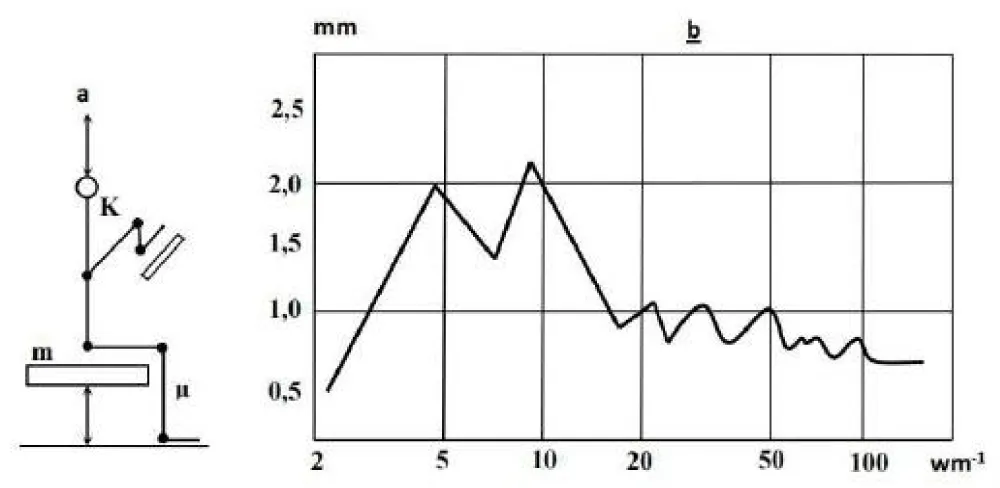
Using the mechanical model of the seated operator, it was possible to determine its amplitude-frequency characteristic: a - in the vertical direction; b - in the horizontal direction, Figure 7.
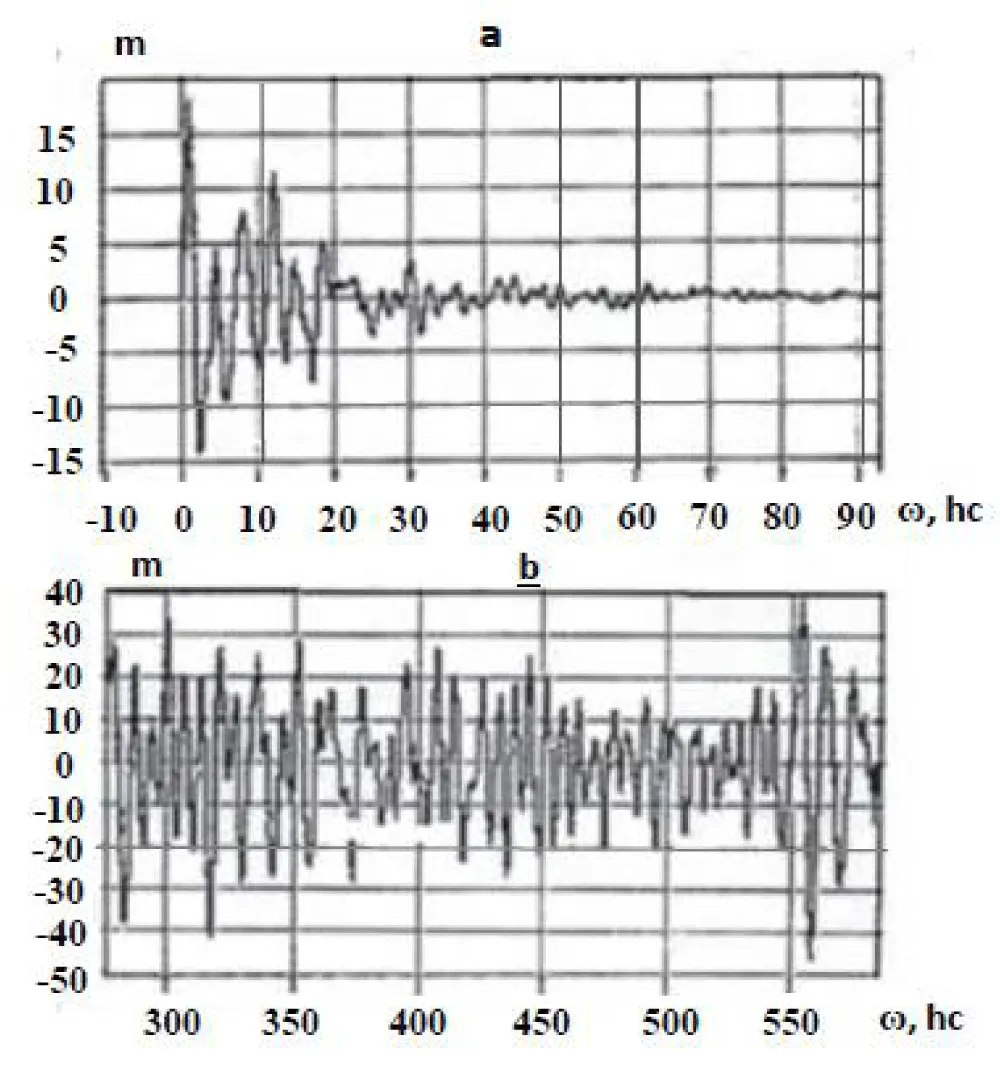
The efficiency of the vibration damping device Kef - is determined as follows
where α0-- vibration acceleration without the use of a vibration damping device; α1-- vibration acceleration when using a vibration damping device. In addition, when ω > 1,41, ω0
where w- is the frequency of forced vibrations, ω0- is the natural frequency of vibrations, then the use of a vibration damping device is effective and the levels of vibration acceleration (vibration velocity) are significantly reduced when using the vibration damping device, when
The system operates completely inefficiently, and the occurrence of self-excitation and, consequently, resonance modes is not excluded. The logarithmic levels of vibration velocities in the average geometric frequency bands at the drill rig operator's workplace in the directions of the x1, y1, z1 axes without using the rig's vibration damping device; and in the directions of the ; x2, y2, z2 axes when using the rig's vibration damping device, are given in Table 2.
Conclusion
Obviously, in our case
This means that the use of a vibration damping device is effective. This fact Kef > 1 once again confirms the validity of the main parameter values of the flexible-damping elements determined as a result of the theoretical studies we conducted.
References
- Gavasheli LS. Theory of vibration protection of nonlinear mechanical systems. Tbilisi: Metznireba; 2006;272.
- Gavasheli LS, Makharadze LI. Transverse damping of main pipelines of hydrotransport systems under the influence of parametric forces. Georgian Eng News. 2016;(2):59-62.
- Metrikine AV, Hagedorn P. Influence of bending-torsion coupling on the vibration of elastic structures. J Sound Vib. 2002;252(4):619-638.
- Rao SS. Mechanical vibrations. 6th ed. Harlow: Pearson Education; 2017. Available from: https://www.amazon.in/Mechanical-Vibrations-Singiresu-S-Rao/dp/013436130X
- Nayfeh AH, Mook DT. Nonlinear oscillations. Weinheim: Wiley-VCH; 2008. Available from: https://www.wiley.com/en-us/Nonlinear+Oscillations-p-9783527617593
Advertisement



 Save to Mendeley