Advances and Applications in Statistics and Probability
Assessment and Predictive Modeling of Bilberry Cactus Extracts as Green Corrosion Inhibitor for Mild Steel surface protection from hydrogen evolution
1Department of Materials and Metallurgical Engineering, Federal University of Technology, Owerri, Nigeria
2Chemical Systems and Data Research Laboratory, Department of Materials and Metallurgical Engineering, Nnamdi Azikwe University, Awka, Nigeria
3Department of Metallurgical and Materials Engineering, National Institute of Technology, Rourkela, India
Author and article information
Cite this as
Dan NE, Taiwo OO, Nwoye C, Behera A. Assessment and Predictive Modeling of Bilberry Cactus Extracts as Green Corrosion Inhibitor for Mild Steel surface protection from hydrogen evolution. Adv Appl Stat Probab. 2026; 3(1):1-7. Available from: 10.17352/aasp.000004
Copyright License
© 2026 Dan NE, et al. This is an open-access article distributed under the terms of the Creative Commons Attribution License, which permits unrestricted use, distribution, and reproduction in any medium, provided the original author and source are credited.Abstract
This paper presents an evaluation of the corrosion behavior of mild steel in hydrochloric acid solution. Mild steel corrosion rates were predicted within the range of 0.0036 - 0.0086gcm-2 h-1, considering hydrogen evolution rates between 0.0086 and 0.0568 ml cm-1 min-1. Bilberry cactus extract has high inhibition efficiencies due to corrosion & hydrogen evolution, reaching (44.76 - 70.83)% and (43.49 - 70.11)%, respectively. These results align closely with the predictions of the derived empirical model. The model expresses corrosion rate as an exponential function given by: where and are mild steel corrosion rate (gcm-2 h-1), hydrogen evolution rate (ml cm-1 min-1), inhibition efficiency due to weight loss or corrosion (%), and inhibition due to hydrogen evolution (%), respectively. These equalizing constants Ϧ and ẞ are 1.0034 and 19.036, respectively. Model predictions deviated by < 6.3% from experimental values, corresponding to an operational confidence level above 93.7%. Its validity is reinforced by the core expression: , where both sides are nearly equal. The standard error in predicting corrosion rates was only 0.0002%, confirming the model’s precision. Furthermore, correlation coefficients between the predicted corrosion rate and inhibition due to corrosion, inhibition due to hydrogen evolution, and the hydrogen evolution rate exceeded 0.94, underscoring the reliability of the model.
Introduction
The corrosion of mild steel in acidic environments, particularly hydrochloric acid, remains a pressing challenge in industrial processes such as pickling, descaling, and oil well acidizing. Conventional inhibitors, though effective, often pose environmental and health hazards as they are considered toxic. Literally, this has stimulated a turning point and hence driven research into plant-based extracts, which are biodegradable and eco-friendly, with fewer environmental implications [1-4]. Over the past two decades, numerous studies have examined the inhibitory potential of various plant extracts, each with distinct phytochemical compositions that enable adsorption onto steel surfaces and the formation of protective films [5-9].
One of the pioneering studies involved pineapple leaf extract, which contains lignin, cellulose, and polyphenolic compounds. Scientists reported inhibition efficiencies exceeding 95% in a hydrogen sulfide environment with a corrosion inhibition concentration of 1 g/L at a temperature of 303K, with adsorption following Langmuir isotherm behavior, which enhanced surface coverage [10]. Similarly, Sida acuta extract has been extensively studied, as some of the researchers demonstrated that its alkaloids, flavonoids, and tannins significantly reduced corrosion rates in acidic media [11-14]. Thermodynamic studies revealed negative Gibbs free energy values, confirming spontaneous adsorption. Polarization measurements showed that Sidaacuta acts as a mixed-type inhibitor, suppressing both anodic dissolution and cathodic hydrogen evolution. Its efficiency was concentration-dependent, with optimal performance at moderate extract levels. Black pepper extract, rich in piperine in the presence of HCl, has been studied [15-18]. Findings from some of the researchers recorded an appreciable increase in corrosion mitigation performance with an efficacy of 92%, which was examined using a polarization approach and electrochemical impedance spectroscopy (EIS). Fourier transform infrared spectroscopy (FTIR) analysis confirmed adsorption of functional groups onto steel surfaces, while kinetic studies showed increased activation energy in the presence of the extract, suggesting reduced corrosion kinetics. The extract’s effectiveness was attributed to the synergistic action of multiple phytochemicals, which provided both physical barrier protection and chemical passivation.
Research on Hunteria umbellata seed husk extract highlighted its potential as a green inhibitor [19,20]. Some studies found inhibition efficiencies of 76.9% and 74% in 5% HCl and H2SO4, respectively. The husk’s alkaloids and tannins were responsible for adsorption, and electrochemical studies confirmed its mixed-type inhibition behavior. Its eco-friendly nature and local availability make it particularly relevant in African industrial contexts and subsequently drive its application. Similarly, the use of pomegranate alkali extract has also been studied by researchers; one of the findings showed that alkali-treated pomegranate peel extract achieved inhibition efficiencies above 80%. The alkali treatment enhanced the availability of active functional groups, improving adsorption capacity. Electrochemical studies revealed that the extract acted as a mixed-type inhibitor, reducing both anodic and cathodic reactions. The adsorption process followed the Langmuir isotherm, and thermodynamic parameters confirmed spontaneous adsorption.
Bilberry Cactus extract has gained attention in recent years [21,22]. In the presence of HCl, the inhibition efficiency showed an increase of 85% at 0.5 g/L concentration, with the increase in efficiency directly related to Bilberry Cactus extract concentration. Hydrogen evolution studies confirmed suppression of cathodic reactions, which was suggested to be due to the presence of extract, while FTIR analysis showed shifts in functional group peaks after adsorption, indicating chemical interaction with steel surfaces. A team of researchers [23] demonstrated that adsorption followed Langmuir and Temkin isotherms, with negative Gibbs free energy values confirming the process of spontaneous adsorption. Bilberry Cactus extract acts as a mixed-type inhibitor, and its phytochemical composition, rich in alkaloids, tannins, saponins, and flavonoids, provides synergistic protection. Compared to other plant extracts, Bilberry Cactus shows superior performance, making it a promising candidate for industrial applications [21]. Taken together, these studies underscore the viability of plant extracts as sustainable corrosion inhibitors. Empirical Modelists have predicted the inhibition efficiency (due to weight loss) of bilberry cactus extract on mild steel corrosion rate, while submerged in HCl acid solution, based on the inhibition efficiency due to hydrogen evolution and hydrogen evolution rate [21].
This paper investigates the surface modification of mild steel due to the presence of HCl in Bilberry Cactus to derive an empirical model. Along with the derived exponential function, the hydrogen evolution rate on which the corrosion rate is dependent is raised to a dimensionless term, which is a ratio of the inhibition efficiencies due to corrosion and hydrogen evolution.
Novelty of the empirical model
Unlike conventional adsorption-based models (Langmuir, Temkin), the empirical model expresses corrosion rate as an exponential function of hydrogen evolution rate and inhibition efficiencies. This is a fresh mathematical approach that captures the synergistic effect of both anodic and cathodic suppression.
By combining inhibition efficiency due to weight loss and hydrogen evolution into a single predictive framework, the model bridges two traditionally separate evaluation methods.
With a standard error of 0.0002% and correlation coefficients above 0.94, the model achieves predictive accuracy rarely reported in corrosion science. This precision makes it more than a theoretical construct- it is a reliable engineering tool.
Practical significance of derived model
The practical significance of the derived model can be seen in industrial applications, such as in oil well acidizing, where hydrogen evolution accelerates steel degradation. Here, the model can forecast inhibitor performance under varying acid concentrations. In pickling and descaling operations, the model enables optimization of inhibitor dosage, reducing chemical waste and cost. In pipeline protection, predictive modeling allows proactive inhibitor selection before field deployment.
The essence of the model can also be captured in eco-friendly engineering. By validating Bilberry cactus extract as a green inhibitor, the model supports industries in transitioning away from toxic synthetic inhibitors, aligning with sustainability goals.
With a deviation below 6.3%, the model provides engineers with a 93-99% confidence level in real-world prediction, reducing trial-and-error experimentation.
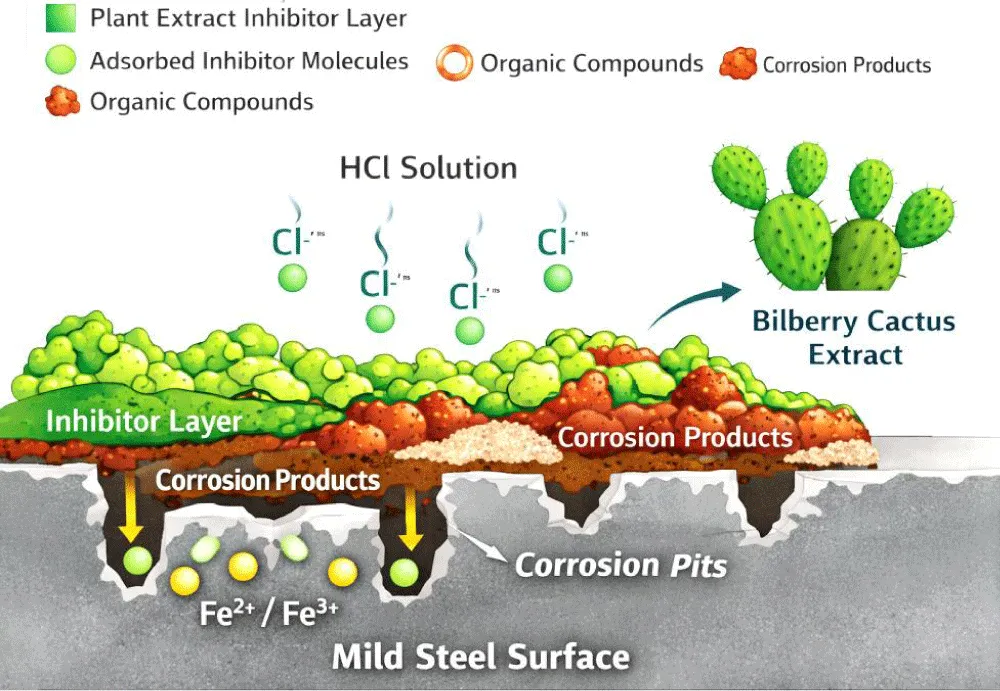
Mild steel coupons were selected as the substrate for corrosion inhibition studies. The chemical composition of the steel was: 0.053 wt% C, 0.14 wt% Si, 0.2 wt% Al, 0.1 wt% Ca, 0.48 wt% Mn, 97.48 wt% Fe, 0.057 wt% Cu, and 0.018 wt% Cr. Before experimentation, the steel surfaces were mechanically polished, degreased with a cleaning agent such as acetone, and it was rinsed with distilled water to ensure a clean and uniform surface. The corrosion inhibitor was derived from bilberry cactus plant extract, which contains bioactive compounds such as flavonoids, tannins, and organic acids. These organic compounds from the plant extract chemically interact with Fe2+ ions to form a complex deposit on the surface, creating a non-uniform protective layer, which increases the measurable surface area, as shown in Figure 1. Inhibitor deposition was achieved using both immersion and absorption techniques to ensure a very good surface coverage. The corrosive medium consisted of 1.5 M HCl, prepared by diluting analytical-grade 37% HCl with double-distilled water. All experiments were conducted using Pyrex beakers. The setup included a micro drilling machine (Model H) for surface preparation, an analytical digital balance (Mettler 4900) for precise weighing of samples, and a calibrated pH meter to monitor solution acidity. Deposition procedures and additional experimental protocols followed methodologies reported in previous studies [23,24].
Model formulation
On the basis of equation 1, a computational analysis has been carried out.
The derived model, shown as a mathematical expression in equation 2, predicts the corrosion rate of mild steel during inhibition by the extract while submerged in HCl. The variables and are the mild steel corrosion rate (gcm-2 h-1), hydrogen evolution rate (ml cm-1 min-1), inhibition efficiency due to weight loss or corrosion (%), and inhibition due to hydrogen evolution (%), respectively. The equalizing constants, Ϧ and ẞ, are 1.0034 and 19.036, respectively. The constants were generated using C-NIKBRAN data analytical memory software [15]. The interaction between these constants and variables ensures that the units on both sides of the derived model are equal.
Boundary and initial conditions
The corrosion behavior of mild steel exposed to hydrochloric acid was governed by the combined influence of the acid medium and the surface-absorbed bilberry cactus extract. The extent of the corrosion that these influenced depended on the HCl concentrations in the solution. In deriving the corrosion model, specific parameter ranges were established to capture the system’s behavior: inhibition efficiency as a result of weight loss between (44.76 -70.83)%, inhibition efficiency due to hydrogen evolution between (43.49 - 70.11)%, hydrogen evolution rate ranging from 0.0086 to 0.0568 ml cm-1 min-1, and observed corrosion rates spanning 0.0036 - 0.0086gcm-2 h-1. These ranges provided the experimental and analytical basis for assessing how variations in hydrogen evolution rate and inhibition efficiencies of bilberry cactus extract (due to weight loss & hydrogen evolution) affected the corrosion susceptibility or resistance of mild steel.
Based on equation 2, Table 1 has been formed, which illustrates how corrosion rates of the mild steel vary with hydrogen evolution rates and inhibition efficiencies of the extract due to weight loss and hydrogen evolution. The evaluated terms on both sides of the model are confirmed to be consistently near-equal. The negligible differences recorded across each dataset confirm that the two sides of the model are essentially balanced. This outcome indicates that any variable assessed through the model will yield highly accurate results, with deviations remaining minimal and well within acceptable limits.
Model validity
The validation of the derived model was carried out by comparing the predicted results with the experimental results, using graphical, statistical, and deviational analysis.
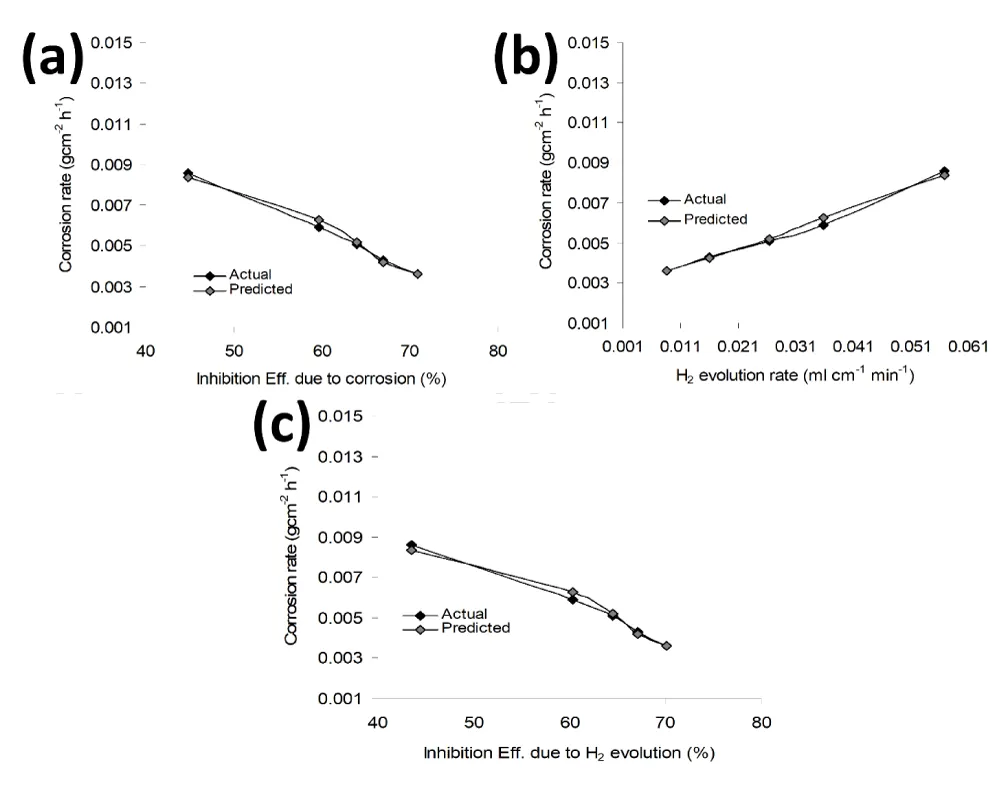
Graphical Analysis: Results obtained from both experimental and model-predicted analyses for comparative assessment are shown in the figures. 2-4, as well as Figure 5, are consistent in all respects. Figure 2a shows a plot of corrosion rate against inhibition efficiency (due to corrosion/weight loss) as obtained from experimental and model-predicted results. Graphical analysis of this figure shows increased inhibition efficiency (due to corrosion/weight loss) with a decrease in corrosion rate of the mild steel. This relationship translates into a negative slope and a spontaneous process. The actual and predicted values show a similar point distribution following close alignment of the curves. The relationship between corrosion rate and inhibition efficiency (due to H2 evolution) is shown in Figure 2b. The plot is characterized by aligned curves of experimental and model-predicted results, which translates into increased inhibition efficiency (due to H2 evolution) with a decrease in corrosion rate of the mild steel. This inverse relationship also gives a negative slope. The actual and predicted values show close alignment of curves and a similar distribution of points. Figure 2c involves a graphical presentation of the mild steel corrosion rate and H2 evolution rate from both experimental and model-predicted results. The figure shows an increased evolution rate with an increase in the corrosion rate of the mild steel, hence emphasizing a positive slope. The actual and predicted values show very aligned and close point-to-point agreement. It can be seen that the predicted value is slightly higher and lower than the actual value, showing a small deviation, which is acceptable as the deviation is related to experimental or modeling errors.
Statistical analysis
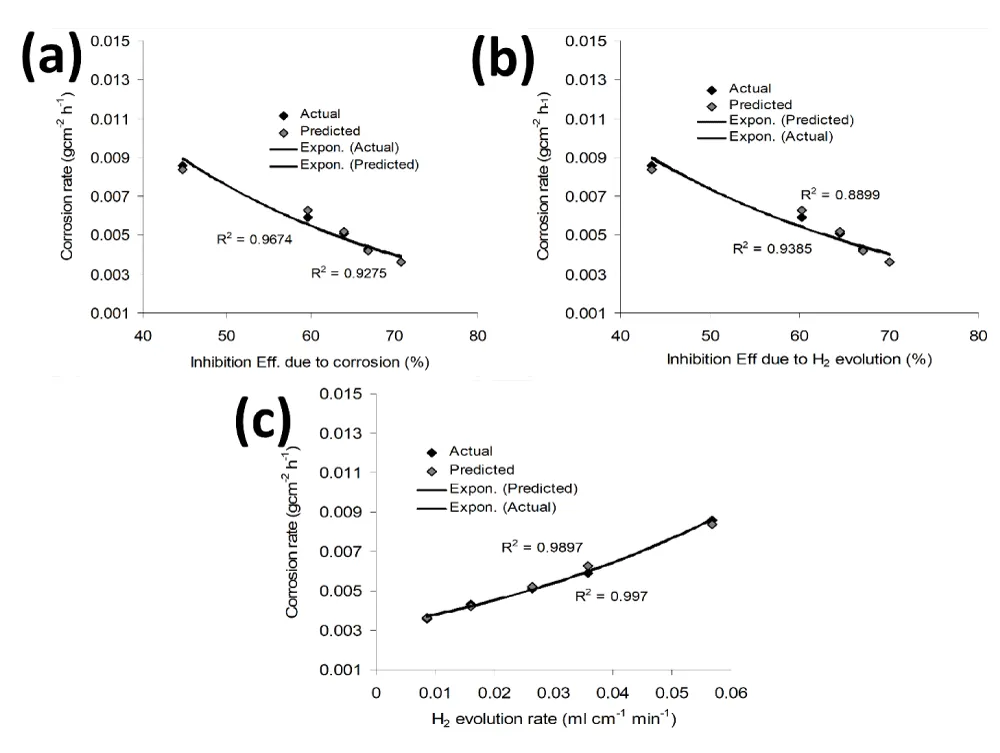
For each variation in hydrogen evolution rate and inhibition efficiencies due to corrosion and hydrogen evolution, the overall standard error incurred in predicting corrosion rate relative to experimental results was determined to be 0.0002%. This corresponds to a model confidence level exceeding 99.9%. The standard error values were also computed using Microsoft Excel (version 2003), further confirming the precision and reliability of the model. Correlation analyses were performed using Microsoft Excel (version 2003), based on the coefficients of determination (R2) presented in Figure 3(a-c). Figure 3a is similar to Figure 2a in terms of points’ trend and distribution, except that it basically shows the correlation between corrosion rate and inhibition efficiency (due to corrosion/weight loss) as 0.9836 and 0.9688 for experimental data and model-predicted results, respectively.Figure3b is also similar to Figure. 2b, following shared characteristics in terms of data spread and trend. It shows that the correlation between corrosion rate and inhibition efficiency (due to hydrogen evolution) is 0.9631 and 0.9433 for experimental data and model predictions, respectively. Furthermore, Figure 3c is very similar to Figure. 2c, considering similarities in the plotted data trend and distribution. It indicates the correlation between corrosion rate and hydrogen evolution rate as 0.9985 for experimental results and 0.9948 for model predictions, respectively. A comparative assessment of these values indicates that the model achieved a slightly stronger fit with the hydrogen evolution rate. This confirms that predicted corrosion rates are primarily dependent on the hydrogen evolution rate [21].
The correlations were calculated using the relationship as in Equation 3
R = √ R2 (3)
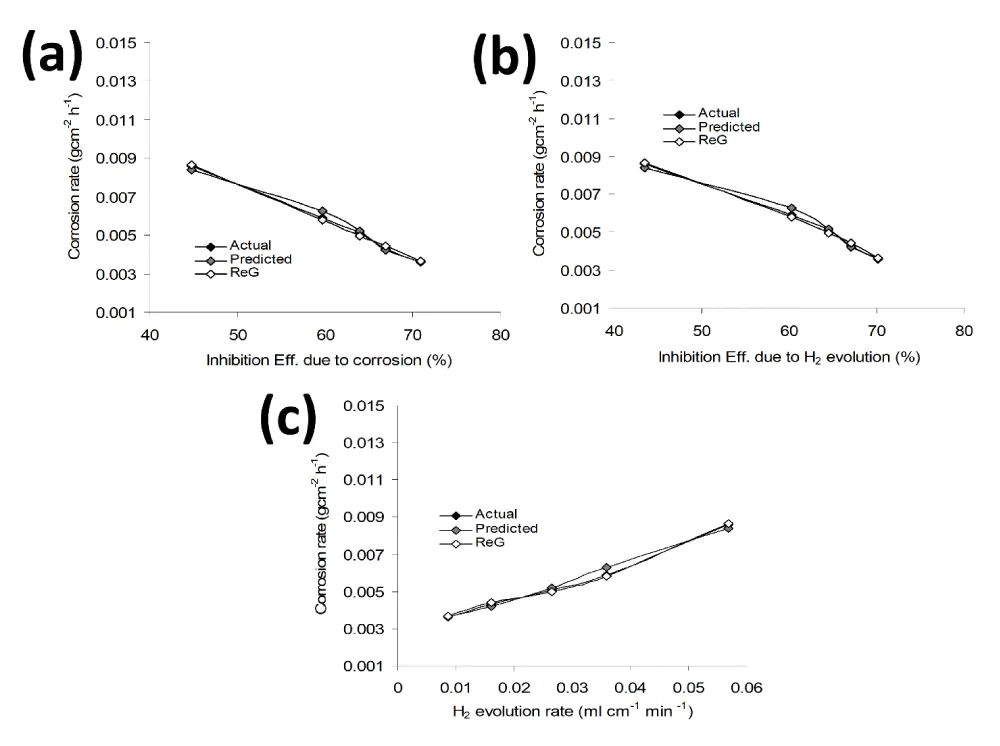
Figure 4presents the curves of experimental, model-predicted, and regression results plotted against the corrosion rate of mild steel relative to inhibition efficiency due to corrosion, inhibition due to hydrogen evolution, and hydrogen evolution rate. Figure 4a shows plots of corrosion rate against inhibition efficiency (due to corrosion/weight loss) as obtained from experimental, model-predicted results, and regression results. The three curves show very close alignment, which translates into close point data distribution, affirming agreement. The relationship between inhibition efficiency (due to corrosion/weight loss) and corrosion rate, as well as slope, is the same for all curves as in Figure 2a. Figure 4b shows the graphical presentation of the results of corrosion rate relative to inhibition efficiency (due to H2 evolution) as evaluated from experimental, model-predicted, and regression models. The closely aligned curves are characterized by similar point –to –point results trend and spread. The figure agrees with Figure 2b, indicating that an increased inhibition efficiency (due to H2 evolution) results in a decrease in corrosion rate of the mild steel, emphasizing also a negative slope. Figure 4c is a plot of experimental, model-predicted, and regression results representing (also as shown in Figure 2c) a direct relationship between the mild steel corrosion rate and H2 evolution rate. The three curves are not only very closely aligned, but also show similar characteristics in terms of the magnitude of point-to-point values, trend & spread of results, and slope within the axes.
The regression analysis was conducted to verify the consistency of the observed trends and distributions in the derived model predictions against the experimental results. The close alignment of the three curves-experimental, model-predicted, and regression-demonstrates a high degree of agreement. This outcome confirms the admissibility and acceptability of the derived model, reinforcing its reliability for predicting corrosion behavior under varying inhibition efficiencies due to corrosion & hydrogen evolution and hydrogen evolution rate.
Table 2 highlights the negligible differences between experimentally determined corrosion rates and those predicted by the model. This consistency provides strong evidence that the derived model is both functional and reliable. The table further shows that these differentials include both positive and negative values when compared to experimental results. Positive values indicate instances where the model slightly overpredicted corrosion rates, while negative values reflect slight underpredictions. Taken together, these balanced variations confirm that the model’s predictions remain accurate, with deviations well within acceptable limits.
Theory Measure and Deviational Analysis: Analysis of the corrosion rates of mild steel, obtained from both experimental measurements and model predictions, revealed slight deviations between the predicted values and the actual results. The theoretical measures obtained through the electrochemical process in the presence of a harsh environment of HCl, which is responsible for the expedited materials degradation process of Fe dissolution to produce Fe2+, and the combined effect of hydrogen evolution. The inhibitor impaired the corrosion rate by enhancing the physisorption and chemisorption process, which led to the formation of a barrier layer and hence blocked the electrochemical reaction. This gave a carrion rate as given in equation 4.
Where CRinh is the corrosion rate with inhibitor, CRo is the corrosion rate without inhibitor, and θ is the surface coverage by inhibitor. The discrepancies between experimental measurement and prediction are attributed to certain assumptions and experimental conditions during field work that were not fully incorporated into the model formulation.
To address this limitation, a correction factor is necessary to ensure closer alignment between model-predicted values and experimental data. Deviation (Dv) (%) of the model-predicted corrosion rate from that of the experimental is given by equation 5
Where, ξm is the model-predicted corrosion rate, and ξE is the corrosion rate evaluated from experimental results.
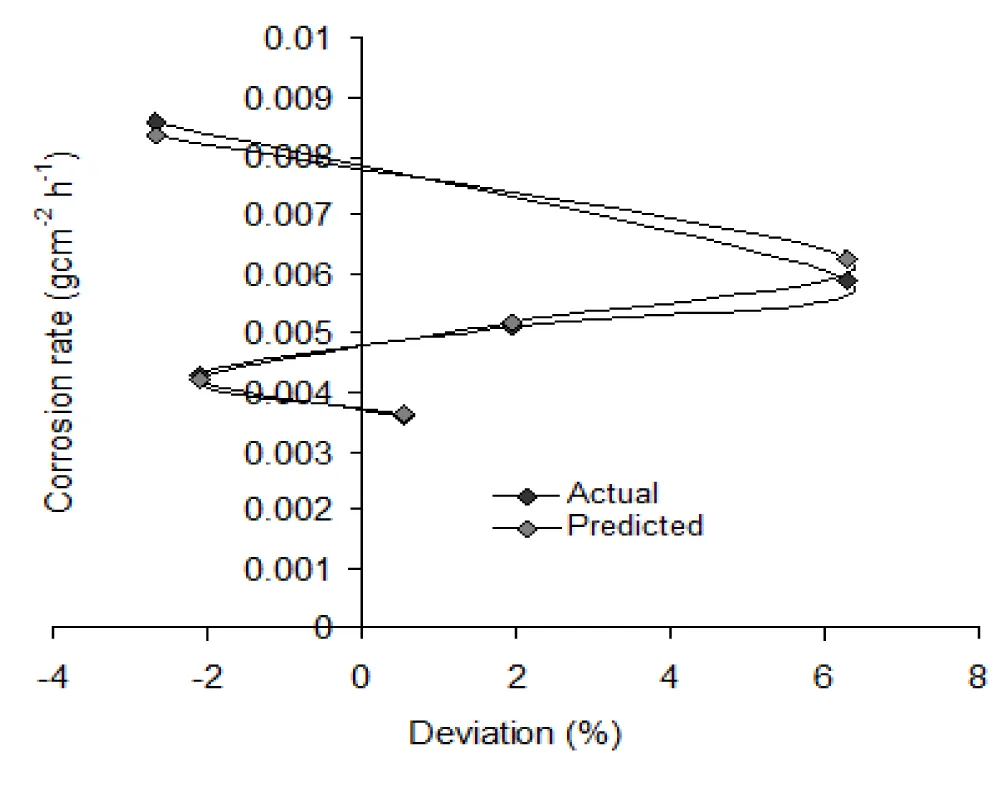
Figure 5 shows the deviation between model-predicted corrosion rates and corresponding experimental values. The overall maximum deviation recorded was 6.27%, corresponding to an operational confidence level above 93.7%. The minimum and maximum deviations observed were 0.56% and 6.27%, respectively. These deviations were directly associated with corrosion rates of 0.00362 and 0.00837gcm-2 h-1, inhibition efficiencies due to corrosion of 70.83 and 44.76 %, inhibition efficiencies due to hydrogen evolution: 70.11 and 43.49 %, and hydrogen evolution rates: 0.0086 and 0.0568 ml cm-1min-1, respectively. Based on these evaluations, the overall confidence level of the model is placed within the range of 93-99%, confirming its reliability and predictive accuracy despite minor deviations. Importantly, the deviation values represent only the magnitude of the difference, while the associated sign indicates whether the model prediction is a deficit (negative sign) or a surplus (positive sign) relative to the experimental result.
The predictive analysis of the surface-modified mild steel corrosion rates in hydrochloric acid results in a gradual increase in corrosion, along with hydrogen evolution, in line with the experimental results. The empirical model, developed from process parameter values, describes the corrosion rate as an exponential function expressed as: . The model predicts corrosion rates with a maximum deviation of less than 6.3% from experimental values, corresponding to an operational confidence level above 93.7%. Its validity is anchored in the core expression: , where both sides are nearly equal. The standard error in predicting corrosion rates was only 0.0002%, confirming the model’s precision. Furthermore, correlation coefficients between the predicted corrosion rate and inhibition due to corrosion, inhibition due to hydrogen evolution, and the hydrogen evolution rate exceeded 0.94, underscoring the robustness and reliability of the model.
This study not only confirms Bilbery Cactus extract as an effective green inhibitor but also introduces a novel empirical model that integrates both corrosion and hydrogen evolution efficiencies into a single predictive framework. The model achieves exceptional precision (0.0002%, confidence > 93%) and provides a practical tool for industries to optimize inhibitor dosage, reduce chemical waste, and ensure sustainable steel protection in processes such as acidizing, pickling, and pipeline maintenance. Its reliability and adaptability make it a valuable step towards wider adoption of eco-friendly corrosion inhibitors.
References
- Raja PB, Sethuraman MG. Natural products as corrosion inhibitors for metals in corrosive media-a review. Mater Lett. 2008;62(1):113-116. Available from: https://doi.org/10.1016/j.matlet.2007.04.079
- Marzorati S, Verotta L, Trasatti SP. Green corrosion inhibitors from natural sources and biomass wastes. Molecules. 2019;24(1):48. Available from: https://doi.org/10.3390/molecules24010048
- Mishra G, Dash SP, Mahapatra SK, Swain D, Rout GR. Deeper insights into the physiological and metabolic functions of the pigments in plants and their applications: Beyond natural colorants. Physiol Plant. 2025;177(2). Available from: https://doi.org/10.1111/ppl.70168
- Mussey B, Damoah L, Konadu D, Akoto R. Concrete rebar corrosion inhibitors-a review of sustainable natural inhibitors. In: Applied Research Conference in Africa. Cham: Springer; 2021. p. 479-492. Available from: https://www.springerprofessional.de/en/concrete-rebar-corrosion-inhibitors-a-review-of-sustainable-natu/19983144
- Godínez-Santillán RI, Kuri-García A, Ramírez-Pérez IF, Herrera-Hernández MG, Ahumada-Solórzano SM, Guzmán-Maldonado SH, et al. Characterization of extractable and non-extractable phenols and betalains in berrycactus (Myrtillocactus geometrizans) and its chemoprotective effect in early stage of colon cancer in vivo. Antioxidants (Basel). 2024;13(9):1112. Available from:
- Montiel-Sánchez M, García-Cayuela T, Gómez-Maqueo A, García HS, Cano MP. In vitro gastrointestinal stability, bioaccessibility and potential biological activities of betalains and phenolic compounds in cactus berry fruits (Myrtillocactus geometrizans). Food Chem. 2021;342:128087. Available from: https://doi.org/10.3390/antiox13091112
- Özkır D. Insight into anti-corrosion effect of Mammillaria prolifera fruit extract as a green inhibitor for mild steel in HCl solution. Eurasian J Sci Eng Technol. 2023;4(2):71-77. Available from: https://dergipark.org.tr/tr/download/article-file/3521852
- Teferi DA, Kassa MG. Cactus-based biopolymers: A review on sustainable innovations in edible packaging, UV protection, antioxidant films, and industrial applications. Food Sci Nutr. 2025;13(12). Available from: https://doi.org/10.1002/fsn3.71163
- Oulabbas A, Abderrahmane S, Salcı A, Gecibesler IH, Solmaz R. Adsorption and corrosion inhibition of cactus cladode extract and effect of KI addition on mild steel in 0.5 M H2SO4. ChemistrySelect. 2022;7(19).
- Chima OM, Ozurumba E, Popoola LT, Archibong FN, Achalla OJ, Asmara YP. Anticorrosion effect of pineapple peel extract on mild steel in hydrogen sulfide environment: Characterization, optimization and statistical analysis via response surface methodology. Eng Rep. 2025;7(11). Available from: https://doi.org/10.1002/eng2.70445
- Eduok U, Umoren S, Udoh A. Synergistic inhibition effects between leaves and stem extracts of Sida acuta and iodide ion for mild steel corrosion in 1 M H2SO4 solutions. Arab J Chem. 2012;5(3):325-337. Available from: https://doi.org/10.1016/j.arabjc.2010.09.006
- Aribo S. Inhibitive performance of Sida acuta and monoethylene glycol on the under deposit corrosion of UNS S30403 stainless steel. Int J Adv Manuf Technol. 2017;93(5-8):1853-1858.
- Ndukwe AI, Anyakwo C. Modelling of corrosion inhibition of mild steel in hydrochloric acid by crushed leaves of Sida acuta (Malvaceae). Int J Eng Sci. 2017;6(1):22-33. Available from: https://www.theijes.com/papers/vol6-issue1/Version-3/D0601032233.pdf
- Muhammad SL, Ibrahim MB. Adsorption, thermodynamic and kinetic studies of Azadirachta indica bark extract as a potential corrosion inhibitor for zinc in 0.25 M HNO3 solution. Appl J Environ Eng Sci. 2022;8(4):257-272. Available from: https://www.researchgate.net/publication/366499609_Adsorption_Thermodynamic_and_Kinetic_Studies_of_Azadirachta_indica_AI_Bark_Extract_as_a_Potential_Corrosion_Inhibitor_for_Zinc_in_025_M_HNO3_Solution
- Quraishi MA, Yadav DK, Ahamad I. Green approach to corrosion inhibition by black pepper extract in hydrochloric acid solution. Open Corros J. 2009;2(1):56-60. Available from: http://dx.doi.org/10.2174/1876503300902010056
- Zarei A, Dehghani A, Guo L, Ramezanzadeh B. Pepper extract effectiveness as a natural inhibitor against corrosion of steel samples in 1 M hydrochloric acid: Theoretical (DFT calculation-MD simulation), thermodynamic, and electrochemical-surface studies. Ind Crops Prod. 2022;189:115839. Available from: https://doi.org/10.1016/j.indcrop.2022.115839
- Dahmani M, Et-Touhami A, Al-Deyab S, Hammouti B, Bouyanzer A. Corrosion inhibition of C38 steel in 1 M HCl: A comparative study of black pepper extract and its isolated piperine. Int J Electrochem Sci. 2010;5(8):1060-1069. Available from: https://doi.org/10.1016/S1452-3981(23)15344-2
- Raja PB, Sethuraman MG. Inhibitive effect of black pepper extract on the sulphuric acid corrosion of mild steel. Mater Lett. 2008;62(17-18):2977-2979. Available from: https://doi.org/10.1016/j.matlet.2008.01.087
- Alaneme KK, Olusegun SJ, Adelowo OT. Corrosion inhibition and adsorption mechanism studies of Hunteria umbellata seed husk extracts on mild steel immersed in acidic solutions. Alex Eng J. 2016;55(1):673-681. Available from: https://doi.org/10.1016/j.aej.2015.10.009
- Baloguna SW, Belloa SA, Emmanuela EO, Alabia AF. Evaluation of titanium (IV) oxide nanopowder-Hunteria umbellata seed extract composite coating on mild steel immersed in acidic media for corrosion inhibition. J Mater. 2025;3(4):365-375. Available from: https://kwasuspace.kwasu.edu.ng/items/ebec396e-7e17-4f04-aef9-3f701b24464c
- Nwoye CI, Okelekwe N. Multi-factorial evaluation of corrosion inhibition efficiency of bilberry cactus extract on mild steel in hydrochloric acid solution. World J Chem. 2020;15(1):9-14. Available from: https://doi.org/10.5829/idosi.wjc.2020.09.14
- Ouyang L, Liang W, Bian C, Shan Y, Wang S. Ultrasound-assisted green natural deep eutectic solvent extraction of flavonoids from wild blueberry: Process optimization, composition identification, and antioxidant activity. Foods. 2025;14(19):3325. Available from: https://doi.org/10.3390/foods14193325
- Abdulrahman A, Kobe I, Aigbodion V, Ganiyu K, Awe C. Thermodynamic behaviour of mild steel corrosion in an environment of bilberry cactus plant extracts in hydrochloric acid solution. J Metall Mater Eng. 2014;9(1):1-14. Available from: https://doi.org/10.62934/jmme.9.1.2014.1-14
- Nwoye CI, Chukwudi BC, Agu PC, Ugwuegbu CC. Model for periodic analysis of the quantity of water evaporated during thermo-processing of clay designated for production of oven refractory. J Miner Mater Charact Eng. 2011;10(13): 1233-1241. Available from: https://www.researchgate.net/profile/Chima-Ugwuegbu-3/publication/267857588_Model_for_Periodic_Analysis_of_the_Quantity_of_Water_Evaporated_during_Thermo-processing_of_Clay_Designated_for_Production_of_Oven_Refractory/links/547b28d70cf293e2da2d5d83/Model-for-Periodic-Analysis-of-the-Quantity-of-Water-Evaporated-during-Thermo-processing-of-Clay-Designated-for-Production-of-Oven-Refractory.pdf?origin=scientificContributions
Advertisement



 Save to Mendeley